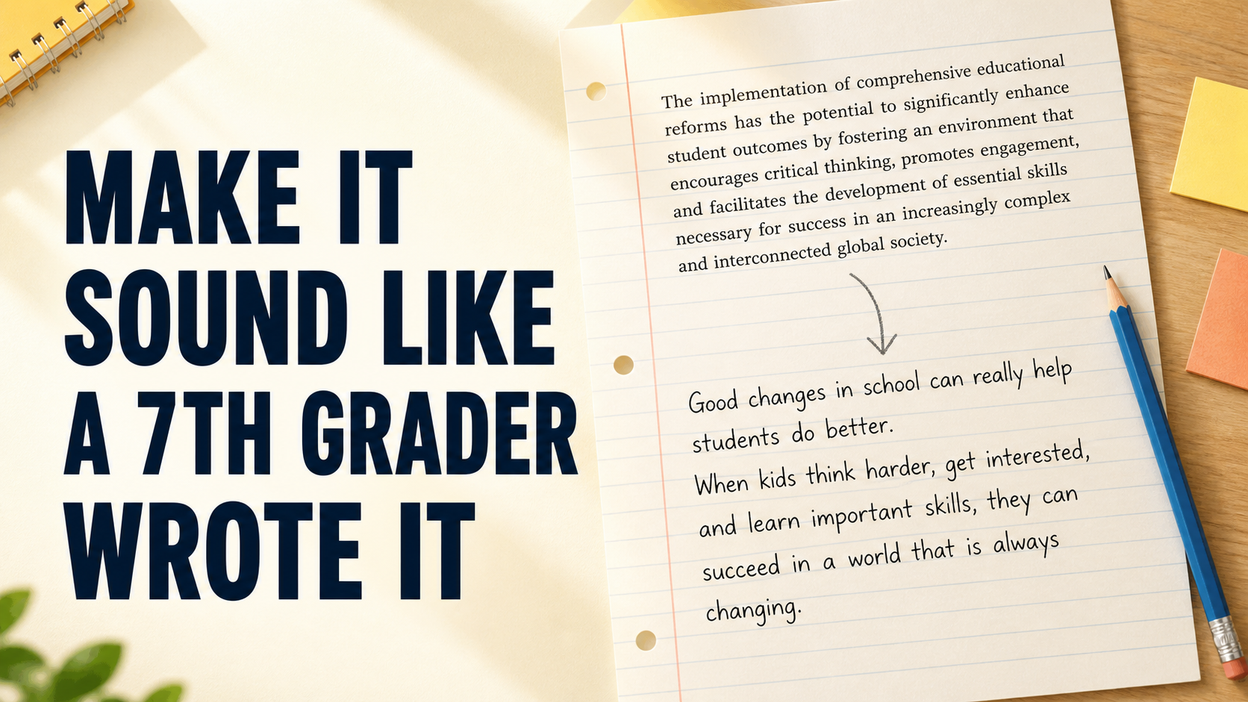
To make it sound like a 7th grader wrote it, you must drop complex words and long sentences. Just write like you talk. For example, instead of saying “The utilization of the device was imperative,” say “We really needed this thing.” This guide gives you a simple, step-by-step process. It is perfect for students who want to improve their essays. The tone should be friendly and direct. Remember, you are not dumbing down your writing. You are making it clearer and more engaging. This method works for school assignments. Later, we will discuss tools that can help with this process. For now, focus on the basics. Start practicing today, and you will see a big difference.
What Does “Make It Sound Like a 7th Grader” Actually Mean?
People use this phrase for two related but different goals:
- A seventh-grade student voice: The text should sound like a real student explaining an idea in their own words. It can be thoughtful and well organized, but it should not sound like a research journal or a corporate report.
- A seventh-grade reading level: The text should be easy for an average seventh-grade reader to understand. This goal also applies to instructions, health information, product pages, emails, and public-facing content written by adults.
Those goals overlap, but they are not identical. An adult can write at a seventh-grade reading level without pretending to be 12 years old. A seventh-grade student can also use technical vocabulary correctly in a science report and produce a passage that receives a higher readability score.
Real seventh-grade writing is not “bad writing.” According to Scholastic’s guide to seventh-grade learning, students at this level are expected to support claims with reasons and evidence, organize ideas logically, use transitions, address opposing claims, and revise their work. They may also use facts, quotations, examples, dialogue, and subject-specific terms. The goal is clearer expression, not fewer ideas.
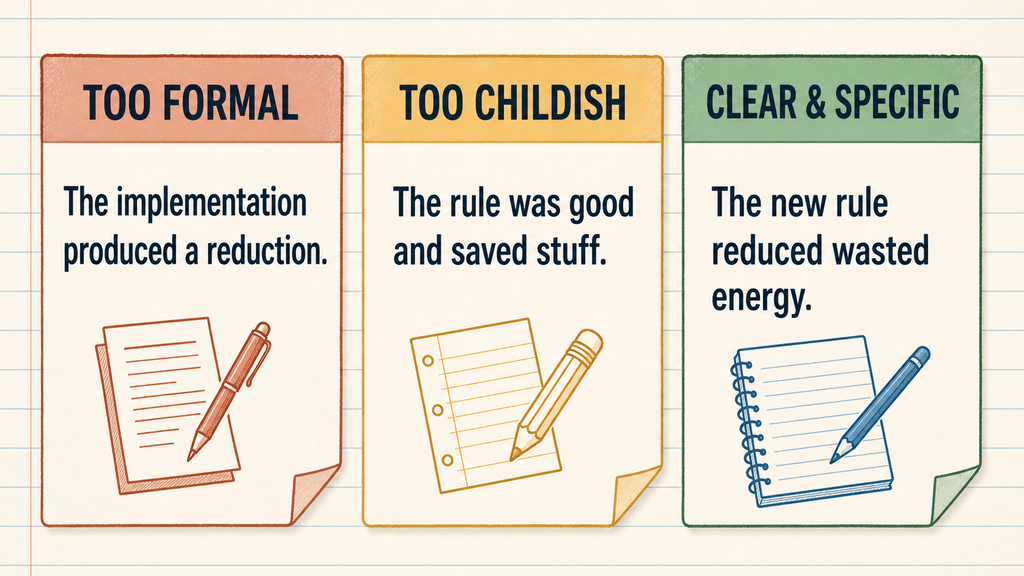
Here is the difference in one short example:
| Version | Example | What it sounds like |
| Too formal | The implementation of the policy produced a measurable reduction in unnecessary energy consumption. | A report or academic paper |
| Too childish | The new rule was good because it stopped people from wasting lots of power. | Oversimplified and vague |
| Better seventh-grade version | The new policy reduced the amount of energy people used when they did not need it. | Clear, specific, and age-appropriate |
The better version keeps the cause and result. It replaces “implementation” and “unnecessary energy consumption” with direct wording, but it does not remove the meaning.
How to Make It Sound Like a 7th Grader Wrote It: The Basics
This section explains the core idea behind this style. The goal is not to write poorly. The goal is to write clearly. Many people think simple writing means low intelligence. That is wrong. Simple writing shows you understand your topic well enough to explain it plainly. It is a skill anyone can learn. And it works for any kind of content.
The Golden Rule: Simple is Smart
The main rule is simple. Always choose the easier word. Always choose the shorter sentence. Always write for your reader, not for your dictionary. This rule applies to everything you write. It helps you avoid confusion. It helps you keep attention.
Why Clarity Beats Complexity
Clear writing helps people understand faster. Researchers Michael D. Aldridge and Kenneth Brownson found that the best reading level for health information is 5th grade. This shows that lowering the grade level helps more people get the message. Douglas Mueller, president of the Gunning-Mueller Clear Writing Institute, noted: “People prefer to read and get information at a level below their capacity. Even a Harvard University professor prefers to get information without strain.” This means everyone likes easy reading. No one wants to work hard to understand a sentence.
William H. Dubay, a readability consultant, adds more evidence. He explains that high school graduates read at the 9th-grade level. College graduates read at the 12th-grade level. But adults read five grade levels lower than their last completed grade. So if you write for college graduates at a 12th-grade level, you lose most of your readers. You need to write below their assumed level to reach more people.
One study tested this idea on a real website. The researchers rewrote the site to read at a 6th to 8th grade level. The results were clear.
| Metric | User Group | Original Site | Rewritten Site |
|---|---|---|---|
| Success Rate | Lower-literacy | 46% | 82% |
| Success Rate | Higher-literacy | 68% | 93% |
| Total Task Time (7 tasks) | Lower-literacy | 22.3 min | 9.5 min |
| Total Task Time (7 tasks) | Higher-literacy | 14.3 min | 5.1 min |
| Satisfaction (1-5 scale) | Lower-literacy | 3.5 | 4.4 |
| Satisfaction (1-5 scale) | Higher-literacy | 3.7 | 4.8 |
All differences were statistically significant. This proves that writing at a 7th or 8th-grade level helps everyone. It does not hurt skilled readers. It helps them too. The lower-literacy group saw a 135% improvement in task time. The higher-literacy group also got faster and more satisfied. This means clear writing benefits all readers.
The Goal is Connection, Not Confusion
Many writers try to sound smart. They use big words and long sentences. But this creates confusion. Readers get lost. They stop reading. They feel frustrated. The real goal of writing is to connect with your audience. You want them to understand your message. You want them to remember it. You want them to act on it.
A simply written message allows readers to focus on the important stuff. They do not get distracted by hard words. Simplicity is a timesaver. Using fewer words makes the message concise. It helps writers get to the point quickly. It saves everyone time. Simplicity also promotes inclusiveness. A message conveyed in simple language can be understood by a broader audience. No one needs a degree, a dictionary, or knowledge of jargon to understand it.
People respond more positively to writing they can easily understand and use.
This is the core truth. Write for easy comprehension. Your readers will thank you. They will stay on your page longer. They will share your content. They will trust you more. This kind of writing builds real connections.
Who is This For?
This style is for anyone who wants to communicate better. But some groups benefit more than others.
Perfect for Students, Bloggers, and Marketers
Students need this skill the most. When you write essays, teachers want to see your ideas. They do not want to decode hard words. Clear writing helps you get better grades. It shows you understand the topic. Students can use this method to make their essays more readable. It also helps them save time. They can write faster when they stop trying to sound fancy. They can focus on their arguments instead of their vocabulary.
Bloggers also benefit. Bloggers write for many different people. Some readers are experts. Some are beginners. Writing at a clear level helps everyone. It keeps readers engaged. It makes them come back for more. It also helps search engines rank their content higher.
Marketers need this skill too. They write to sell products. They write to build trust. Clear writing helps them connect with their customers. It makes their message stick. It drives action. A confused reader will not buy anything.
The key point is this. This style is not about dumbing down your content. It is about making it accessible. It is about reaching more people. It is about communicating effectively. Anyone can learn this skill. It just takes practice.
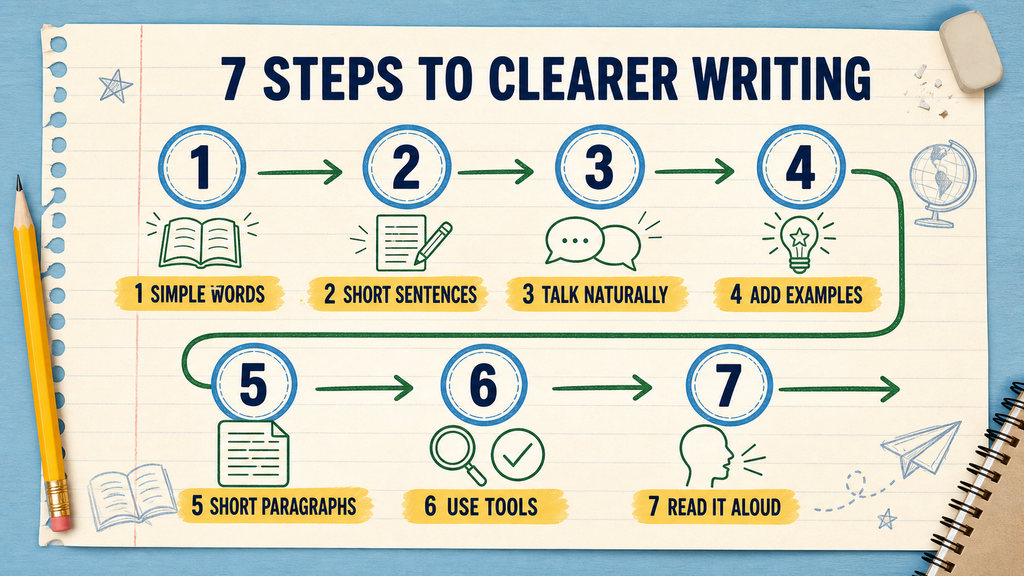
7 Ways to Make Writing Sound Like a Real 7th Grader
Step 1: Swap Big Words for Small Ones
The first step to make it sound like a 7th grader wrote it is simple. You must replace complex words with everyday ones. This change makes your writing easier to read. It also helps your readers move faster through your text. Research shows that increasing vocabulary complexity slows down reading speed. In a review of 26 studies, reading rate decreased in 73% of those studies when text got harder. Comprehension also dropped in 54% of them. So big words do not make you sound smarter. They just make your readers work harder.
Use “Use” Instead of “Utilize”
Plain language guidelines are clear on this point. Use simple, everyday words. For example, substitute the word use for utilize and the word buy for purchase. This advice comes straight from official writing guides. The reason is simple. Overly complex words force readers to burn extra mental energy. They have to figure out what the words mean. This leads to confusion and frustration.
Use common, everyday words. For example “use” instead of “utilize”.
When you choose the simpler word, you reduce cognitive load. Your readers can focus on your message instead of your vocabulary. This matters for everyone. It matters for busy professionals. It matters for students who are trying to understand new topics. It even matters for you when you write your own essays. You want your ideas to shine, not your dictionary skills.
Say “Help” Not “Facilitate”
Here is a quick list of fancy words and their simpler cousins:
- Utilize → Use
- Facilitate → Help
- Commence → Start
- Terminate → End
- Purchase → Buy
- Subsequent → Next
- Sufficient → Enough
Keep this list handy when you write. If you catch yourself using a big word, ask one question. Would I say this word to a friend? If the answer is no, swap it out. A thesaurus can help you find simpler synonyms. But be careful. Some thesaurus suggestions sound too formal. Pick the word that feels natural in conversation.
Cut the Fluff and Filler Phrases
Filler words sneak into our writing without notice. They add no meaning. They just take up space. Eliminating filler words can cut your word count by 25-30%. That is a huge improvement. For example, “An octopus is sitting on my car” has 7 words. “This question is interesting” has 4 words. Both sentences are clear. The second one is leaner.
Common fillers include just, so, very, really, and that. These words often appear when we are unsure. We add them to soften our statements. But they weaken our message. Read your sentence aloud. If it works without the filler, delete it. Your writing will feel sharper and more confident.
Remove “In Order To” and “Due To The Fact That”
Some phrases are longer than they need to be. “In order to” can become just “to.” “Due to the fact that” can become “because.” These small changes add up. They make your sentences shorter. They make your writing easier to scan. They also make your text feel more direct. Your readers will appreciate the clarity.
Define Unavoidable Big Words
Sometimes you cannot avoid a big word. Maybe it is a technical term. Maybe it is the exact word for your topic. In those cases, do not panic. Just explain it right after you use it.
Explain a Hard Word Right After You Use It
Here is an example. “The new policy will expedite the process. That means it will make things faster.” See how that works? You use the big word. Then you give the simple meaning. This way, your readers learn something new. They do not get stuck. This technique works well in essays and blog posts. It shows you know your topic. It also shows you care about your readers.
Remember, the goal is connection. Simple words build bridges. Big words build walls. Choose the bridge every time.
Step 2: Master the Art of Short Sentences
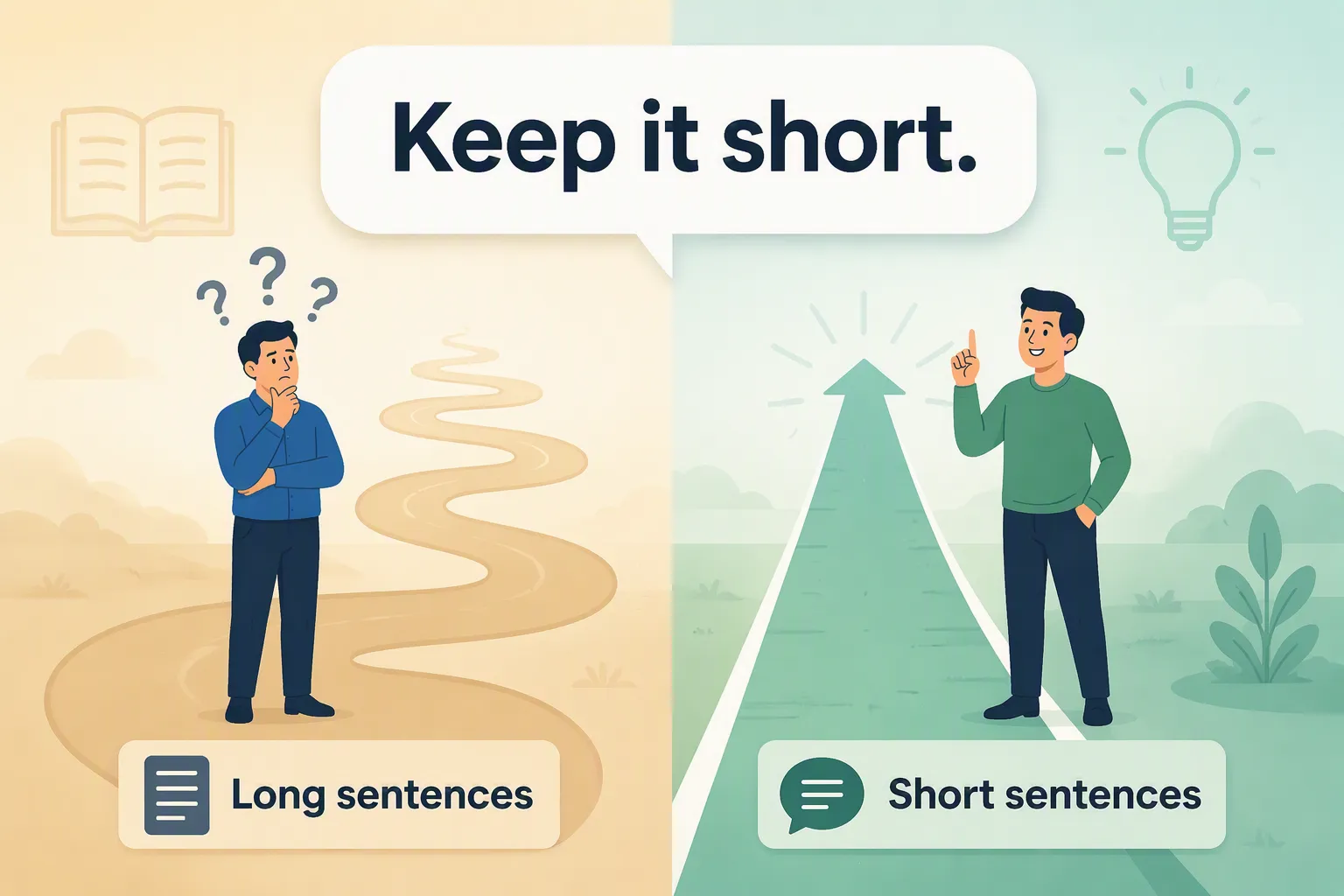
Long sentences tire readers. They force people to hold many ideas at once. Short sentences give the brain a break. Each one delivers a single thought. This makes your writing easier to follow. It also makes your message stronger. When you master short sentences, your text becomes clearer. Your readers stay engaged. They understand your point faster.
Research supports this approach. According to a study by Kadayat and Eika (2020), readers feel comfortable when sentences contain between 16 and 20 words. This range improves comprehension. It also helps people who use screen readers. The data shows a clear pattern.
| Average Sentence Length (words) | Reader Comprehension |
|---|---|
| 8 or fewer | 100% (fully understood) |
| 14 | More than 90% |
| 21 | Fairly difficult to read |
| 25 | Difficult to read |
| 29 or longer | Very difficult to read |
| 43 | Less than 10% |
The message is obvious. Keep your sentences near 14 words. Your readers will understand almost everything. Push past 25 words, and you lose them.
One Idea Per Sentence
Each sentence should carry one thought. That is the rule. When you pack two or three ideas together, readers get lost. They must untangle your meaning. This takes effort. Many readers simply give up.
Break Down Complex Thoughts
Look at this example. “The experiment failed because the temperature was too high, and the equipment was old, so we had to start over with new gear.” That is one long sentence with three ideas. Here is the fix. “The experiment failed. The temperature was too high. The equipment was old. We started over with new gear.” Each sentence now holds one idea. The meaning stays the same. The clarity improves dramatically.
This technique helps students write better essays. When you break down complex thoughts, your arguments become easier to follow. Teachers can see your logic clearly. They do not have to guess what you mean. Your grades will reflect this improvement.
The Power of the Period
The period is your best friend. It stops the sentence. It gives readers a moment to breathe. Many writers rely too much on commas. They connect everything with “and.” This creates run-on sentences. These are hard to read.
Stop Relying on Commas and “And”
Consider this sentence. “She walked into the room and saw the mess and immediately started cleaning and then called her friends for help.” It feels endless. Now try this version. “She walked into the room. She saw the mess. She started cleaning. Then she called her friends.” The shorter sentences create a rhythm. Each action stands alone. The reader processes each step easily.
This style also works well on mobile devices. Most people read content on their phones now. Long sentences wrap awkwardly on small screens. Short sentences display cleanly. They keep the reader moving down the page. This improves the reading experience for everyone.
Vary Sentence Length for Rhythm
Short sentences are powerful. But using only short sentences gets boring. The rhythm becomes choppy. Readers feel like they are reading a list. You need variety. Mix short and medium sentences. This creates a natural flow.
Keep It Mostly Short, But Mix It Up
Different sentence lengths create different feelings. Here is how pacing works in writing:
- For fast pacing (action, chase, fight, crisis, high emotion): Use shorter sentences. Simple structures. Fewer conjunctions. Sometimes fragments. Example: “The door burst open. She ran. Footsteps behind her. Faster. Not fast enough.” The short, choppy rhythm creates urgency.
- For slow pacing (introspection, description, quiet moments): Use longer sentences with more complex structure. Let sentences breathe and expand. Example: “She stood at the window watching rain trace patterns down the glass, thinking about everything that had led to this moment, all the small choices that had seemed meaningless at the time.” The longer rhythm forces readers to slow down.
- For building tension: Start with varied, moderately long sentences, then progressively shorten as tension mounts. Example: “She heard something in the basement, a sound like footsteps but not quite right, too slow and too heavy. She stood at the top of the stairs. Listened. Waited. Another sound. Closer.”
- For emphasis: Use a short sentence after several longer ones. Example: “He’d been planning this for months, carefully considering every angle, making sure there were no holes in his story, no way anyone could prove what really happened. And then she walked in.” The final short sentence lands because of everything before it.
This variety keeps readers interested. It adds drama to your writing. It holds attention from start to finish. When you want to make it sound like a 7th grader wrote it, remember this balance. Use shorter sentences as your default. Add longer ones for effect. This approach works for any type of writing. It works for blog posts. It works for school essays. It works for emails. Practice this skill daily. Your writing will transform.
Step 3: Write Like You Talk
The fastest way to make it sound like a 7th grader wrote it is to write the way you speak. Read your draft out loud. Does it sound stiff? Does it sound like a robot wrote it? If yes, you need to rewrite it. Your voice on the page should match your voice in conversation. This shift creates a conversational tone that readers trust and enjoy.
Use Contractions Without Fear
Contractions are shortened word pairs. “Do not” becomes “don’t.” “It is” becomes “it’s.” These small changes make a huge difference. They make your writing feel human. They make it feel warm.
The numbers prove this point. Human writers use contractions more often than academic writing, and AI-generated text falls in between. This gap explains why contracted writing feels natural. It matches how people actually talk.
“It is important to note that I am committed” becomes “It’s important to note that I’m committed,” which immediately sounds less like a consultant and more like a person.
See the difference? The second version sounds like someone you could have a conversation with. The first version sounds like a memo. When you write essays, contractions help your personality show through. Teachers read hundreds of papers. A natural voice stands out.
“Don’t” Instead of “Do Not”
Practice this swap every time you write. “Don’t” feels casual. “Do not” feels formal. “I’m” feels friendly. “I am” feels distant. These tiny changes add up across a full page. Your writing becomes easier to read. It becomes more enjoyable too.
“It’s” Instead of “It Is”
This contraction appears everywhere in conversation. Use it in your writing. The same rule applies to “we’re,” “they’re,” “you’re,” and “can’t.” Each one brings you closer to a natural speaking rhythm. Your readers will not notice the contractions. They will just feel like your writing is easy to follow.
Start Sentences with “And” or “But”
Many students learn a rule that does not exist. They hear that sentences cannot begin with “and” or “but.” This belief has no historical or grammatical foundation. Style guides agree on this point.
- Adams Sherman Hill (The Principles of Rhetoric, 1896): “Objection is sometimes taken to employment of but or and at the beginning of a sentence; but for this, there is much good usage.”
- The American Heritage Dictionary (4th ed.): “But may be used to begin a sentence at all levels of style.”
- Kingsley Amis (The King’s English): “The idea that and must not begin a sentence or even a paragraph, is an empty superstition. The same goes for but.”
- New Hart’s Rules (Oxford University Press): “It’s not grammatically incorrect to do so, however, and many respected writers use conjunctions at the start of a sentence to create a dramatic or forceful effect.”
- Chicago Manual of Style Online (5.203): “There is a widespread belief—one with no historical or grammatical foundation—that it is an error to begin a sentence with a conjunction such as and, but, or so.”
- The Bible (Genesis 1:2): “And the earth was without form, and void; and darkness was upon the face of the deep. And the Spirit of God moved upon the face of the waters.”
It’s Okay to Break the Old Rules
Starting with “but” creates emphasis. It signals a contrast. It grabs attention. For example: “Many people fear flying. But driving is actually more dangerous.” The word “but” makes the second sentence hit harder. This technique works well for students who want their arguments to stand out. Use it with confidence.
Ask Rhetorical Questions
Rhetorical questions do not need answers. They make readers think. They create agreement. They pull people into your message.
Get the Reader Thinking and Agreeing
Ask something like “Have you ever struggled to understand a textbook?” Your reader nods. They relate. They keep reading. This connection builds trust. It also breaks up long passages. Questions add variety to your rhythm. Use them at the start of paragraphs. Use them after big ideas. Just do not overdo it. One or two per page works best.
Interjections like “Wow!” or “Oh no!” can add emotion too. Use them sparingly. Too many feel childish. The goal is natural conversation, not a cartoon. Practice these techniques daily. Your writing will sound more human. Your readers will thank you.
Step 4: Make It Relatable with Examples and Analogies
Abstract ideas are hard to understand. They float in your head with nothing to hold onto. Examples and analogies give those ideas a shape. They connect new information to things you already know. This connection makes learning stick. Research shows that analogies link abstract concepts to familiar experiences. They use your body and senses to understand tricky topics. When you explain something new, compare it to something old. Your readers will thank you.
Use Everyday Comparisons
Everyday comparisons turn confusing topics into simple pictures. Think about how you explain a computer to someone. You might say the CPU is like a brain. It processes information. It tells other parts what to do. This comparison works because everyone knows what a brain does. The same logic applies to any topic you write about.
Compare a Process to Making a Sandwich
Let us say you need to explain how a factory works. You could describe supply chains, assembly lines, and quality control. That sounds boring. Instead, compare it to making a sandwich. First, you gather ingredients. That is the supply chain. Then you put them together in order. That is the assembly line. Finally, you check that everything looks right. That is quality control. Suddenly, the factory makes sense. Your readers see the whole process in their minds.
Research supports this approach. Many teaching assignments use bridge analogies with familiar objects to explain abstract concepts. Teachers who prepared their analogies carefully got better results. The key is to pick comparisons your audience already knows. A video game reference works for younger readers. A cooking reference works for almost everyone.
Tell a Quick, Personal Story
Stories grab attention. They make your message feel real. When you share a tiny personal moment, readers connect with you. They see you as a person, not just a writer. This connection builds trust. It also helps readers remember your point long after they finish reading.
Share a Tiny Anecdote to Prove Your Point
Imagine you are writing about the importance of planning. You could list reasons why planning matters. Or you could tell a short story. “Last week, I tried to bake cookies without reading the recipe first. I mixed salt instead of sugar. The cookies were terrible.” That tiny story proves your point better than any list. Readers laugh. They nod. They remember.
Personal stories trigger deep processing in the brain. When readers connect ideas to their own experiences, they create strong memory pathways. They also release dopamine during those “aha moments.” This chemical makes learning feel good. One teacher described how sharing personal journal responses transformed her classroom. Students who never spoke suddenly participated. Their stories became the center of learning. The same principle works in your writing.
Use Simple Metaphors
Metaphors paint pictures with words. They compare two different things to reveal a deeper truth. A good metaphor makes a big idea feel small and manageable. It gives readers a shortcut to understanding.
Explain a Big Idea with a Simple Picture
Here is an example. “Your brain is like a filing cabinet. Each memory goes into a specific drawer. When you learn something new, you create a new folder.” This metaphor helps readers visualize how memory works. They can picture the drawers and folders. The abstract concept becomes concrete.
Research warns about one danger. Analogies can create misconceptions if you only point out similarities. You must also address the differences. A brain is not literally a filing cabinet. It does not have metal drawers. But the comparison still helps. Just remember to note where the analogy stops working. This prevents confusion. It also shows your readers that you understand the topic deeply. Use metaphors sparingly. One strong image beats five weak ones. Your essays will shine when you master this skill.
Step 5: Keep Paragraphs Short and Punchy
Long paragraphs look like a wall of words. They scare readers away. Short paragraphs add white space. They make your writing feel easy to read. This is a key rule for writing on the web. Tools like Lunote also help you improve readability. They can show you paragraphs that are too long.
The One to Three Sentence Rule
Every paragraph should have one to three sentences. That is the rule for online writing. A paragraph can be just one sentence. Online writing needs to be short. For most digital content, short paragraphs work best. For SEO, keep paragraphs reasonably short. Shorter paragraphs with white space make reading easier and keep users interested.
Make Your Text Look Easy to Read
Think about how you read online. You scan. You do not read every word. Short paragraphs match this habit. They let your eyes move quickly down the page. They also help students reading on their phones. Shorter sentences and paragraphs are easier to read on mobile devices. Your screen is a different shape than a computer monitor. A paragraph that looks short on a desktop can fill a whole phone screen. For mobile-first content, use very short paragraphs. This keeps your text easy to manage.
The table below shows the best paragraph lengths for different situations.
| Context | Recommended length | Core reason |
|---|---|---|
| Blog posts and web content | Short | Online readers scan instead of reading fully. White space helps them find info and remember it. |
| Mobile-first content | Very short | Paragraphs that look short on a desktop can take up a whole phone screen. Shorter is needed for mobile reading. |
Use Line Breaks for Emphasis
A line break gives an idea its own space. It tells the reader that this sentence matters. Use this trick to highlight your main points.
Give Important Ideas Their Own Space
Look at this example. “The experiment failed because the temperature was too high. The equipment was old. We started over.” The second sentence stands alone. It gets more attention. The reader pauses on it. This works for any kind of writing. Use it in your essays. Use it in your blog posts. The extra space around a sentence makes it feel important.
Break Up Long Lists into Bullet Points
Long lists inside paragraphs are hard to read. Your brain has to pick out each item. This takes work. Bullet points do that work for your reader. They create clear boxes in the mind. This makes the information easier to scan and remember.
Make Information Easy to Scan
Eye-tracking research from Nielsen Norman Group shows an F-shaped reading pattern for online readers. They first scan across the top. Then they move down and scan a few words across the second line. Finally, they skim down the left side. They catch headings, bullet points, and keywords. This means bullet points match natural reading habits. They make it easier to scan and take in information.
Your short-term memory can only hold a limited number of things at once. Your brain groups related bits of information together. This is called chunking. It breaks big ideas into clear mental boxes. That is why bullet points and subheadings are memory tools. They make information easier to take in and remember.
The serial position effect, found by psychologist Hermann Ebbinghaus, explains that people remember the first and last items in a list best. Bullet points use this by putting each idea in a clear, separate spot. Every point gets a fair chance to be remembered. Each new point feels like progress. This keeps the reader moving forward.
Here is a comparison between a dense paragraph and bullet points.
| Dense Paragraph Format | Bullet Point Format |
|---|---|
| Our shop offers handmade soaps, hand-drawn greeting cards, dried flowers, and home-baked cookies. You can also order online or give us a call. | Our shop offers: • handmade soaps • hand-drawn greeting cards • dried flowers • home-baked cookies. You can also: • order online • give us a call. |
The bulleted version creates clear boxes in the mind. The information is easier to scan. This helps you remember better. Use bullet points when you have three or more items. Break down complex ideas into easy pieces. Your readers will process the information faster. They will remember more of what they read.
Step 6: Use Tools to Help You Sound Human
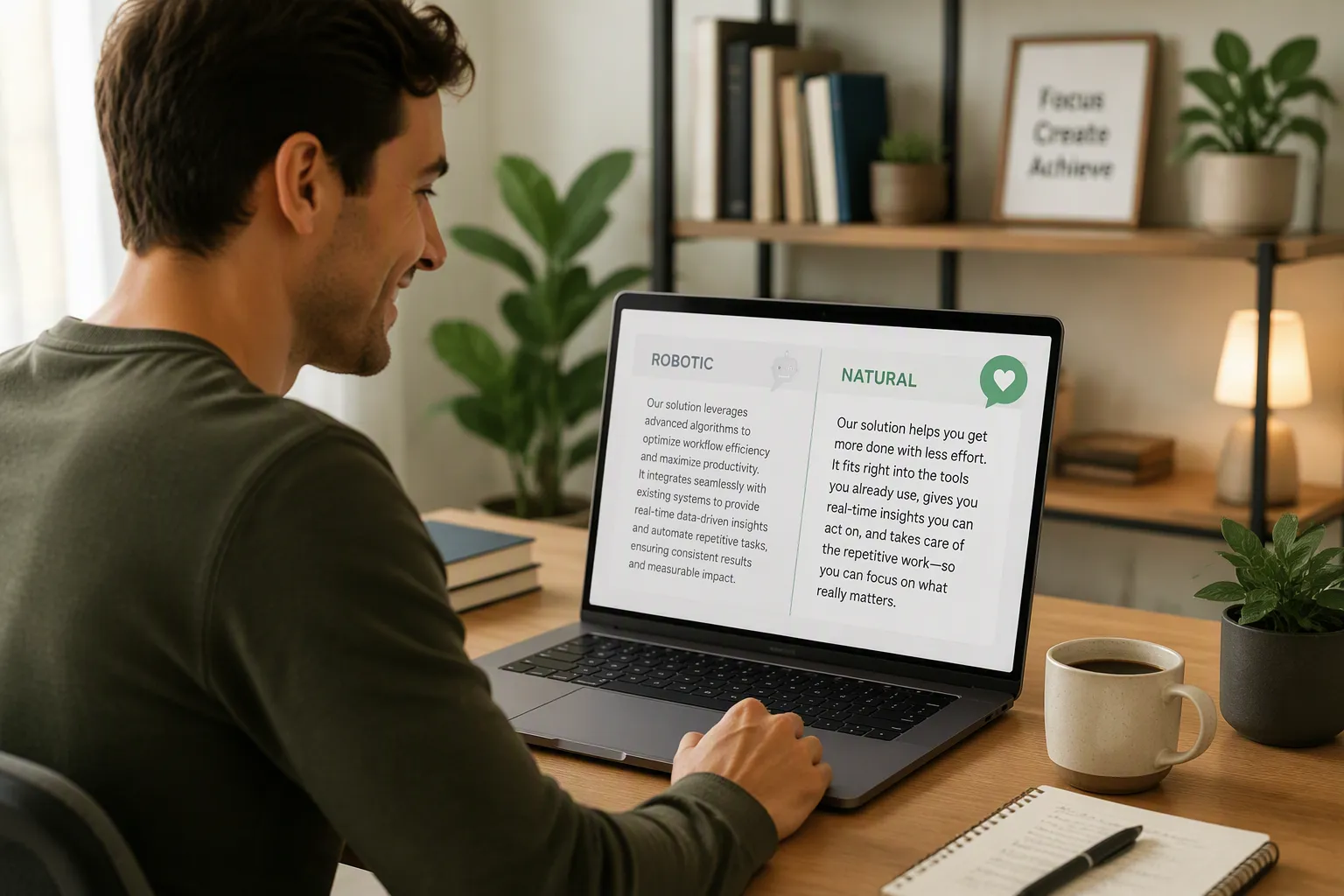
You have learned the steps to write like a 7th grader. You swap big words for small ones. You write short sentences. You write like you talk. You add examples. You keep paragraphs short. But sometimes your writing still sounds robotic. You cannot tell why. The words are simple. The sentences are short. Something still feels off. This is where tools can help. An AI humanizer catches the patterns you miss. It gives your writing a second look. This section explains how these tools work and why they help.
When You’re Stuck, Try an AI Humanizer
An AI humanizer rewrites robotic text into natural language. It fixes small problems your eye misses. The sentences feel stiff. The rhythm is flat. The tone sounds like a machine. The tool changes those patterns. It makes your writing sound human again. This is useful for students who write essays and for bloggers who write posts. You can use it after you finish your draft. Or you can use it when you start with AI-generated text. The tool works fast. It saves you time. It helps you focus on your ideas instead of your words.
How AI Humanizers Can Rewrite Your Draft
AI humanizers are tools that turn robotic text into natural writing. They keep your original meaning while improving the flow. These tools offer features that work together to make your writing better.
- Meaning-Preserving Rewriting: The tool keeps your original ideas, facts, and message intact. It does not change what you said. It only changes how you said it.
- Natural Sentence Flow: The tool improves rhythm, sentence variety, and transitions. It reduces the mechanical feel that comes from AI writing.
- Tone Customization: You can adjust the text for academic, professional, casual, persuasive, or concise styles. This means you can use the same tool for different types of writing.
- Built-In AI Detection Review: You can check your humanized text against detectors like GPTZero and Turnitin. This gives you confidence that your writing passes AI checks.
- Fast Re-Humanizing: You can refine the same content again for a more natural, simple, formal, or polished version.
- All-in-One Writing Workspace: The tool combines generation, humanizing, detection, readability checks, and polishing in one platform.
These tools often support multiple languages, including English, Spanish, French, German, and others. They remove stiff machine tones from major global languages. They mimic native speaking habits. They can help your text sound more human, which means your rewritten text has a better chance of passing AI detectors. They are a reliable option for students and professionals who need authentic content.
Many tools also include a free trial. You can test them on a short piece of writing before you commit. This is perfect for trying out a paragraph from your schoolwork or a blog post. You can see the difference for yourself. The side-by-side comparison shows the before and after. This helps you learn what natural writing looks like.
The Benefits of a Second Pass
Writing is a process. Your first draft is never your best. You need to revise. You need to edit. A second pass helps you catch mistakes. An AI humanizer gives you a fresh perspective. It sees patterns your brain ignores. You become blind to your own writing. You read what you intended, not what you wrote. The tool reads what is actually there. This makes it a valuable partner in your writing process.
Catching Robotic Phrases You Missed
AI-generated text has common problems. It often lacks variation in sentence length and structure. Human writing has short and long sentences mixed together. AI writing often has the same sentence length throughout. AI humanizers can inject this variation to create a natural rhythm.
AI text also lacks unpredictability. Human writing surprises you. It uses unusual word choices. It has emotional shifts. AI writing is predictable. AI humanizers can add vivid scenes, specific details, and conversational language to enrich sentence structures and mimic human thought.
These tools can address common AI issues such as removing statistical fingerprints, reducing over-reliance on transitions, increasing lexical diversity, breaking repetition of patterns, and fixing mechanical phrasing.
Many tools offer multiple modes for different contexts, such as quick fixes, more complex rewriting, conversational tone, and formal academic style. You can choose the mode that fits your needs. They preserve your original meaning while making the text more natural and engaging.
A second pass with an AI humanizer catches the robotic phrases you missed. It gives you confidence. You know your writing sounds human. You know your readers will connect with it. This is the final step in making your writing feel like a 7th grader wrote it. Use the tool. Check your work. Publish with pride.
Step 7: Read It Aloud and Revise
This step is simple but powerful. You must read your work out loud. Your ears catch problems your eyes miss. This technique helps you find awkward phrasing. It helps you fix stiff language. Practice makes this skill stronger over time. The more you try, the more natural it becomes.
Your Ears Are Your Best Editor
Your eyes can trick you. When you read silently, your brain fills in missing words. It corrects grammar mistakes. It smooths over rough sentences. Your ears do not do this. They hear exactly what is on the page. This makes them a better editor than your eyes.
Read aloud: Be sure to read a sentence aloud in order to hear what it sounds like. Does it sound “off”? How would you explain your idea to a friend? Can you rephrase your sentence based on how you would orally explain it?
This strategy works because it forces you to compare your written text against natural speech. You hear the difference between how you wrote and how you talk. The “off” sound tells you something needs to change. The follow-up questions guide you toward a better version.
If It Sounds Stiff, Rewrite It
Some sentences look fine on paper but sound terrible out loud. They feel robotic. They lack rhythm. When you hear this, stop and rewrite. Ask yourself what makes the sentence feel stiff. Is it too long? Are the words too formal? Is the structure confusing? Fix each problem one at a time.
After you write your script, read it out loud or record it and listen back. That’ll help you see if it works in spoken form. If you find you’re running out of breath mid-sentence, it’s too long. Do things sound clunky or artificial? Are you stumbling over certain words? If so, make changes.
This advice applies to any type of writing. When you run out of breath, the sentence is too long. Break it into two shorter ones. When you stumble over words, the phrasing is awkward. Rewrite it with simpler language. These signals tell you exactly what needs to change.
Ask Yourself: “Would I Say This to a Friend?”
This question is your final test. After you finish writing, imagine you are talking to a friend. Would you use these exact words? If the answer is no, you have more work to do. This test helps you maintain a conversational tone. It keeps your writing grounded in natural speech.
Use That Question as Your Final Test
Apply this test to every sentence. Read it aloud. Ask if it sounds like something you would say. If it sounds like a textbook, rewrite it. Your goal is to sound like a real person. A real person talking to another real person. This does not mean your writing lacks sophistication. It means your writing connects with readers.
A Quick Practice Guide for Students
Students can use this technique to improve their essays. The process is simple. Pick a paragraph from your last essay. Read it aloud. Mark every sentence that sounds stiff. Then rewrite those sentences using the steps from this guide. Swap big words for small ones. Shorten long sentences. Add contractions. Use examples.
Try Rewriting a Paragraph from Your Last Essay
Here is a practice exercise. Take a paragraph from an old essay or an AI-generated text. Rewrite it using the methods you learned. Read it aloud again. Compare the two versions. The new version should sound more natural. It should feel like someone talking, not like a machine. This exercise helps you internalize the steps. With practice, you will write this way naturally. You will not need to check every sentence. The style will become your own voice.
Before-and-After 7th-Grade Rewriting Examples
The most useful way to understand a grade-level rewriter is to see what it should preserve. The examples below cover different assignments because a history response should not sound exactly like a personal narrative.
Example 1: History Paragraph
Original
The proliferation of printed political pamphlets accelerated the dissemination of revolutionary ideas throughout the colonies, enabling arguments about taxation and representation to reach audiences beyond established political institutions.
Weak rewrite
A lot of pamphlets made everyone want a revolution because taxes were bad.
Better seventh-grade rewrite
Printed political pamphlets helped revolutionary ideas spread through the colonies. They allowed more people to read arguments about taxes and representation, even if those people were not part of the government.
Why the better version works: It breaks one dense sentence into two, explains “dissemination,” and preserves the important limitation about audiences outside political institutions. The weak version invents a universal claim—“everyone”—and reduces a complex issue to “taxes were bad.”
Example 2: Science Explanation
Original
Photosynthesis is a biochemical process through which plants convert light energy into chemical energy, although its rate can be limited by factors such as light intensity, carbon dioxide concentration, and temperature.
Weak rewrite
Photosynthesis is when plants eat sunlight and turn it into food.
Better seventh-grade rewrite
During photosynthesis, plants use light energy to make chemical energy that they can store. The process may slow down when there is not enough light or carbon dioxide, or when the temperature is not suitable.
Why the better version works: It keeps the scientific relationship and the word “photosynthesis.” It also preserves the qualifier “can be limited.” The weak version may be memorable, but plants do not literally eat sunlight, so the simplification introduces an error.
Example 3: Argumentative Writing
Original
Although opponents argue that later school start times would interfere with sports and family schedules, evidence concerning adolescent sleep supports shifting the school day because adequate rest can improve students’ attention and well-being.
Weak rewrite
Schools should start later because students are tired, and sports are not as important as sleep.
Better seventh-grade rewrite
Some people argue that starting school later would make sports and family schedules harder to manage. However, research on teen sleep suggests that a later start could help students pay attention and feel better during the day. Schools should consider both concerns when deciding on a schedule.
Why the better version works: A seventh grader can present a counterargument and respond to it. The rewrite keeps both sides instead of turning the paragraph into a one-sided opinion. If the original assignment includes a source, the final draft should name and cite it rather than leaving “research” unsupported.
Example 4: Personal Narrative
Original
Upon entering the unfamiliar auditorium, I experienced considerable apprehension, which gradually subsided once I recognized a classmate seated near the stage.
Weak rewrite
I went in and was super scared, but then I saw my friend and was fine lol.
Better seventh-grade rewrite
I felt nervous when I walked into the auditorium because I did not know where to sit. Then I spotted Maya near the stage. She waved me over, and my shoulders finally relaxed.
Why the better version works: It replaces abstract language with a specific moment. The name, wave, and physical reaction make the voice more personal. The weak version adds forced slang and removes the scene. A natural student voice comes from details, not deliberate errors.
Example 5: Instructions for a Younger Audience
Original
Prior to initiating the experiment, participants should verify that all required materials are present and that the work surface is free from potential contaminants.
Better seventh-grade reading-level rewrite
Before you start the experiment, check that you have every material on the list. Clean the work surface so dirt or other substances do not affect the results.
Why this version is different: It is written for a seventh-grade reader, not necessarily by a seventh-grade student. Direct instructions, “you,” and a brief reason make the procedure easier to follow.
How to Make Writing Sound Like a 7th Grader With Lunote
An AI rewriter is most useful when it gives you an editable draft rather than a final answer you submit without reading. This workflow keeps the meaning and the writer’s responsibility in the process.
Step 1: Start With Your Own Draft
Write down the claim, evidence, and examples you need before rewriting. A rough draft is fine. Starting with your own thinking makes it easier to notice when a tool changes the point or adds something you never intended to say.
If you are working from a source, keep the source open. Rewriting does not remove the need to cite borrowed facts, ideas, or quotations.
Step 2: Paste a Manageable Section Into the AI Humanizer
Open the Lunote AI Humanizer and paste one paragraph or short section at a time. Smaller sections are easier to compare, especially when the text contains dates, names, formulas, quotations, or assignment-specific vocabulary.
Do not paste private student records, confidential feedback, or personal information into any online tool unless your school or organization has approved that use. Check the current Lunote pricing and plan information if the amount of text you can process matters to your workflow.
Step 3: Give a Specific Grade-Level Instruction
“Make it simpler” is too vague. Tell the tool what must stay and what should change. This reusable prompt works for most paragraphs:
Rewrite this paragraph in a natural seventh-grade voice. Keep the main claim, evidence, facts, numbers, names, and subject vocabulary. Replace unnecessarily formal words with familiar ones, explain difficult terms briefly, and vary the sentence length. Do not add new facts, fake quotations, slang, grammar mistakes, or a childish tone.
For a personal narrative, add:
Keep my first-person point of view and the details that show what I saw, heard, thought, or felt.
For an argumentative essay, add:
Keep the counterargument and make the connection between each piece of evidence and my claim clear.
For material intended for seventh graders, add:
Address the reader directly where useful and explain any term they need in order to follow the instructions.
Step 4: Compare Meaning, Not Just Vocabulary
Read the source and rewrite side by side. Check every proper noun, number, quotation, cause-and-effect relationship, and qualifier. Words such as “may,” “often,” “some,” and “under certain conditions” matter. A rewrite that changes “may improve” to “will improve” is easier to read but less accurate.
Also look for missing reasoning. A tool may preserve the first and last sentence while cutting the evidence that connects them. Put that evidence back.
Step 5: Make the Voice Yours
Replace generic examples with ones you would choose. Add a relevant observation, class detail, or explanation in your own words. Remove phrases you would never say. Then read the paragraph aloud. If you run out of breath, split the sentence. If every sentence has the same length or structure, combine or vary a few.
You can use the Lunote AI Detector as one signal during review, but a detector score cannot prove who wrote a passage. It should not replace source checking, draft history, or a conversation about the work.
Step 6: Check the Assignment One More Time
Confirm the required length, format, citations, and point of view. Make sure the final response answers the actual question. A smooth paragraph can still receive a poor grade if it ignores the prompt.
A Practical Seventh-Grade Writing Checklist
Use this checklist after a rewrite. It is more useful than chasing one readability number.
Meaning and Evidence
- The main idea is easy to identify.
- Every important fact, date, name, number, and quotation is accurate.
- Reasons and evidence support the claim instead of merely repeating it.
- Technical terms that the assignment requires are kept and explained.
- Qualifiers such as “may,” “usually,” or “in this study” have not disappeared.
- Sources are still cited where needed.
Language and Flow
- Familiar words replace formal words when the simpler choice means the same thing.
- Long sentences are split when they contain too many ideas.
- Short and medium-length sentences are mixed so the writing does not sound mechanical.
- Transitions show how ideas connect, but every paragraph does not begin with “Furthermore” or “In conclusion.”
- Pronouns have clear references. The reader knows who “they” and what “it” mean.
- The paragraph can be read aloud without stumbling over unnecessary phrases.
Voice and Age Appropriateness
- The writing sounds clear, not babyish.
- It does not contain forced slang, random emojis, or mistakes added to imitate a student.
- Personal writing includes specific details rather than generic emotions.
- Argumentative writing can acknowledge another view.
- The writer understands and can explain every sentence.
What to Replace
| Instead of | Try | But check this first |
| utilize | use | “Utilize” may be necessary in a quotation or technical name. |
| numerous | many | Keep an exact number when one is available. |
| demonstrates | shows | “Demonstrates” may have a specific meaning in a rubric. |
| due to the fact that | because | Make sure the cause is actually supported. |
| a significant number of | many or the exact number | “Significant” can also mean statistically significant. |
| in order to | to | Usually safe unless emphasis is intentional. |
| individuals | people, students, or participants | Use the most accurate group name. |
| consequently | so, as a result | Keep the logical relationship. |
Simple writing is not created by swapping every “big word.” Sometimes a precise word is shorter and clearer than a long explanation. Keep vocabulary such as “photosynthesis,” “democracy,” “denominator,” or “metaphor” when the subject requires it, and explain it in context.
Readability formulas can help identify dense passages, but they estimate difficulty using features such as sentence and word length. They do not know whether an explanation is accurate, whether an example fits the audience, or whether the writer sounds authentic. As writing advice summarized by Inc. points out, clear words and shorter sentences can make business communication easier to read as well. That does not turn professional writing into student writing.
Conclusion
Sounding like a 7th grader means writing with clarity, connection, and confidence. It is not about being childish. It is about respecting your reader’s time and attention.
Remember the key steps: simple words, short sentences, and your own voice. Use contractions. Start with “and” or “but.” Add relatable examples. Keep paragraphs brief.
Start practicing today. Try it on your next email or social media post. You will see the difference immediately.
When you are in a hurry, tools like Lunote can help. They catch robotic phrases you missed. They give you a second opinion.
This skill is a superpower. Clear writing builds trust. It opens doors. Use it well.
Your readers will understand you better. They will remember your message. They will come back for more.
FAQ
Will This Style Make My Writing Sound Childish?
No. Clear writing shows you know your topic well. You are not making ideas simpler than they are. You are taking away confusion. Readers like writing that respects their time. Simple words can carry strong ideas well.
Can I Use This Style for Academic Essays?
Yes. Teachers want to get your arguments. They grade ideas, not big words. Short sentences and plain words help your logic stand out. Your essay becomes easier to follow. Your grades will probably get better.
How Long Does It Take to Learn This Style?
Most writers see improvement after a short period of practice. The steps are easy. Swap big words. Shorten sentences. Read out loud. Each try makes the style feel more natural. With continued practice, it becomes your normal way of writing.
Do I Need to Use Tools Like Lunote Every Time?
No. Tools help when you feel stuck or in a hurry. They catch robotic patterns you might miss. But practice builds the skill. Soon, you will write naturally without help. Use tools as a backup, not a habit.
What If My Teacher Expects Formal Writing?
Check your assignment rules first. Some formal papers need specific styles. But most teachers like clear writing. You can keep a professional tone while using simple words. Ask your teacher if you are not sure what they want.
Does This Style Work for Professional Emails?
Yes, for sure. Busy professionals like short, clear messages. They do not want to figure out hard sentences. Simple writing shows you value their time. It also makes you look sure of yourself and organized. Your message gets read and understood faster.