
Is ZeroGPT accurate? Not consistently: while ZeroGPT claims over 98% accuracy, independent testing puts it closer to 73.8% overall and shows that it wrongly flags about 20.51% of human-written text as AI-generated. That means it can catch obvious AI writing, but it also mislabels roughly one in five human essays.
The question “Is ZeroGPT Accurate?” matters to students, educators, writers, editors, and anyone using AI detectors to judge originality or academic integrity. A false positive at that rate can unfairly accuse a student or undermine a writer’s credibility, so knowing the tool’s limits is essential before trusting its score. This article looks at ZeroGPT’s marketing claims versus outside test results, its false positive problem, how it compares with tools like GPTZero and Lunote, and when to use alternatives or extra review for high-stakes decisions.
Key Takeaways
- ZeroGPT says it is 98% accurate, but separate tests found it is only right 73.8% of the time.
- ZeroGPT incorrectly marks about 20% of human-written content as AI.
- People who learn English as a second language see their writing marked as AI 62.5% of the time.
- ZeroGPT works best on AI text that hasn’t been changed or edited, not on human writing or edited versions.
- For big decisions, use more reliable tools like Turnitin or Lunote.
- Always double-check ZeroGPT results with other methods before trusting them.
- ZeroGPT is a fast checking tool, not a final decider of who wrote something.
Is ZeroGPT Accurate? A Direct Answer
ZeroGPT Accuracy at a Glance
| Question | Short answer |
|---|---|
| Is ZeroGPT accurate? | It can detect obvious, unedited AI text, but its performance varies substantially by dataset and writing type. |
| Can ZeroGPT be wrong? | Yes. It can produce both false positives on human writing and false negatives on AI-generated writing. |
| Is ZeroGPT accurate for essays? | It performed strongly on one controlled physics-essay dataset but much worse on a newer multidisciplinary abstract dataset. An essay score is not proof of misconduct. |
| Is ZeroGPT as accurate as Turnitin? | There is no stable conversion between their scores. Turnitin uses a different model and institutional workflow, so ZeroGPT cannot predict a Turnitin result. |
| Is GPTZero or ZeroGPT more accurate? | In one recent scholarly-publication study, GPTZero substantially outperformed ZeroGPT. That does not guarantee the same ranking on every type of text. |
| Is ZeroGPT free? | Yes. It is marketed as a free AI detector, and the free version currently lists 15,000 characters per detection; free scans are fine for quick checks, but limits apply. Paid plans raise limits and add batch checks and reports. |
| Should teachers rely on it? | Only as one screening signal followed by human review and authorship evidence, because accuracy matters in high-stakes decisions. |
| Should writers rewrite until the score is zero? | No. That can damage meaning and voice without proving authorship. Preserve evidence of your writing process instead. |
The Verdict on ZeroGPT Accuracy
“Is ZeroGPT Accurate?” needs a careful answer. The tool works okay but often makes mistakes. ZeroGPT says it is 98% accurate. Independent tests show something different. A 2026 study looked at 160 human-written texts. It found that 20.51% were wrongly flagged as AI. That means about one in five human essays gets marked as AI. ZeroGPT can detect AI, and it is better at identifying ai generated text when the output is raw and unedited. It struggles to identify human writing correctly.
No AI detector is 100% accurate. Users must know this fact. ZeroGPT is very sensitive to AI text. It rarely misses AI content. This trade-off creates a big weakness. The tool can produce false positives, including cases where genuine human writing is marked as ai made. Independent reviews from 2024-2025 show two main risks. False positives happen more often in formal academic writing. Light editing or paraphrasing easily tricks the tool. ZeroGPT works for quick checks but not as proof. Confidence scores should not be used as evidence in important decisions, especially when avoiding false positives matters for real users reviewing their own writing.
The table below shows key findings from independent tests.
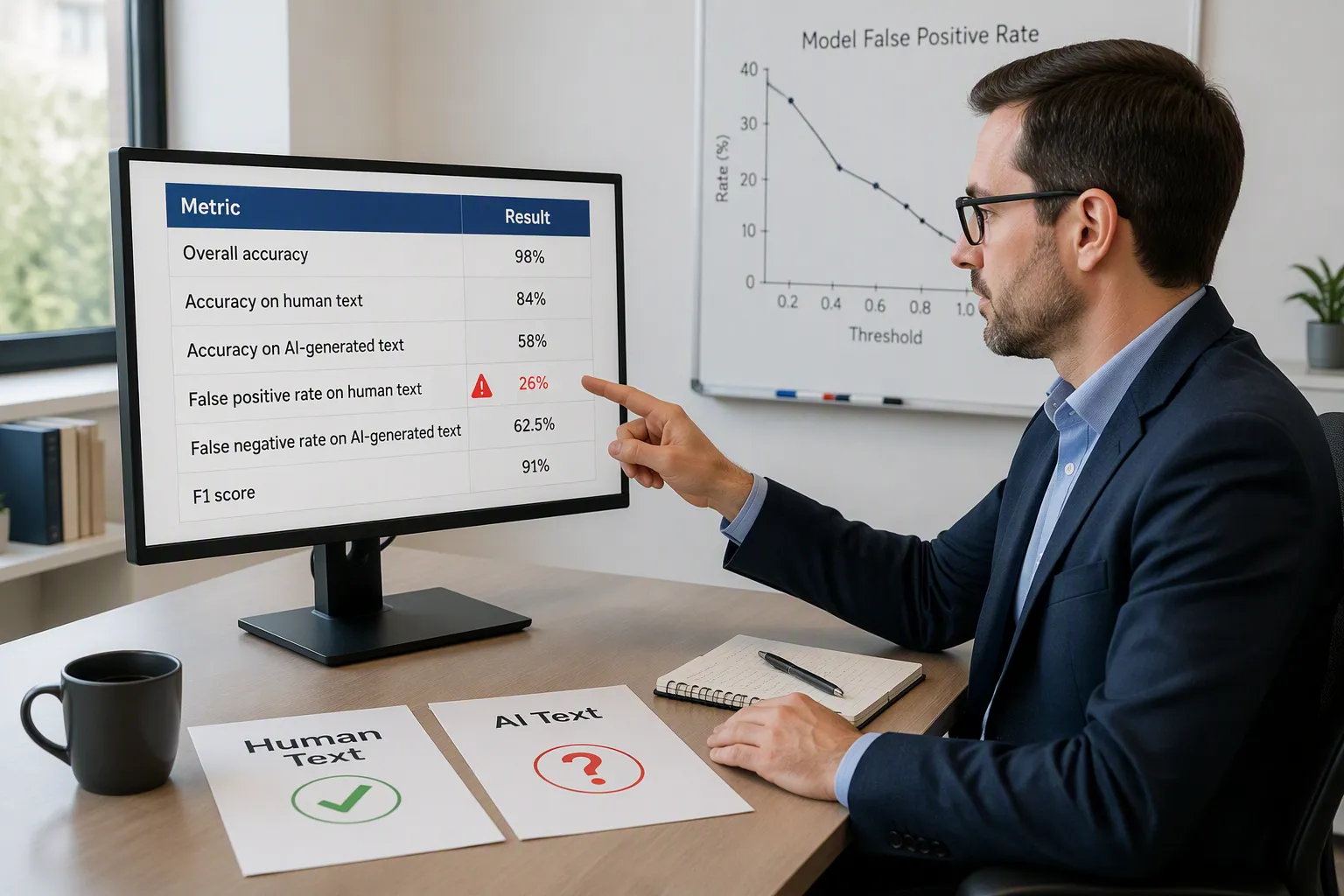
| Metric | Result |
|---|---|
| ZeroGPT self-reported accuracy | 98% |
| Independent test accuracy on pure AI text | 84% (42/50 samples) |
| Independent test accuracy on lightly edited AI text | 58% |
| False positive rate on human text | 26% (13/50 samples flagged as AI) |
| False positive rate on non-native English writing | 62.5% |
| Accuracy when confidence score > 90% | 91% |
These numbers show the gap between claims and real performance. The false positive rate on human text hits 26% in one test. The rate for non-native English writing jumps to 62.5%. This means ZeroGPT flags more than half of all non-native English writing as AI.
Understanding the False Positive Problem
The false positive problem is ZeroGPT’s biggest weakness. The tool wrongly flags human writing as AI at a high rate. This causes real harm for students and writers.
What a 20.51% False Positive Rate Means
A 20.51% false positive rate means that for every 100 human-written texts, about 20 to 21 get flagged as AI. This is not a small issue. The chart below compares ZeroGPT accuracy across different test scenarios.
The chart shows that accuracy drops sharply for lightly edited AI text and non-native English writing. The tool works well on pure AI text but fails on human writing. A comparison with GPTZero shows the trade-off.
| Metric | ZeroGPT | GPTZero |
|---|---|---|
| False Positive Rate (human text flagged as AI) | 50% | 3.3% |
| False Negative Rate (AI text missed) | 10% | 35% |
| Accuracy on AI blog posts | 95% average probability | 84% average probability |
ZeroGPT has a false positive rate of 50% in one test. GPTZero shows only 3.3%. ZeroGPT catches AI text well. It mislabels half of all human writing. This makes it unreliable for general use.
Real-World Impact on Students and Writers
The real-world impact of this false positive problem is serious. Students face accusations of cheating. Writers lose credibility. The quote below captures the core issue.
ZeroGPT flagged 62.5% of non-native English writing as AI-generated. This is not a minor issue. It means ZeroGPT is systemically biased against millions of writers whose first language is not English. If you are an educator using ZeroGPT to check student papers, your international students are significantly more likely to be falsely accused.
This bias affects real people. A student who writes in a second language uses simpler words. They use regular sentence structures. These patterns overlap with AI generation. ZeroGPT sees these patterns as AI signals. The result is a false accusation. This is why many users feel ZeroGPT has too many false positives on formal human writing.
The table below shows which text types face the highest risk of false positives.
| Text Type | Reason for False Positive | Likelihood |
|---|---|---|
| Formulaic content (five-paragraph essays, product descriptions, technical documentation) | Predictable patterns overlap with AI generation | Highest |
| Non-native English speaker text | Simplified vocabulary and regular sentence structures resemble AI output | High |
| Short passages (e.g., 100 words) | Less statistical data for analysis | High |
| Technical writing (instructions, how-to guides) | Rigid structures match AI patterns | High |
| Heavily edited AI text | Mixed human/AI signals create ambiguity | Moderate |
Formulaic content carries the highest risk. Non-native English writing and short passages follow closely. Technical writing also triggers false positives. These patterns explain why the “Is ZeroGPT Accurate” question does not have a simple yes or no answer. The tool works well for pure AI text. It fails for large categories of human writing.
The evidence shows that ZeroGPT should not be used as sole evidence in high-stakes decisions. The 20.51% false positive rate means that one in five human texts gets flagged. This is too high for academic or professional settings. The tool is useful for quick checks. It is an inconsistent and less reliable tool for high-stakes use. Users must understand these limitations before trusting the results.
What Is ZeroGPT, and How Does It Work?
ZeroGPT is an online AI content detector designed to estimate whether text resembles writing generated by ChatGPT, Gemini, Claude, or another large language model. A user pastes text or uploads supported files, runs a scan, and receives an overall classification, an AI percentage, and highlighted sentences that the system considers likely to be AI-generated.
ZeroGPT markets its detection system as DeepAnalyse technology and advertises accuracy above 98%. The public site does not provide enough information to independently reconstruct the complete training set, current decision threshold, performance by genre, or confusion matrix behind that universal claim. That does not mean the claim is automatically false; it means the number should be read as a vendor statement until it is reproduced on a relevant independent dataset.
AI detectors generally look for statistical patterns associated with generated text. These may include predictable word sequences, unusually even sentence structure, repeated transitions, low variation, and other relationships learned by a classifier. The detector does not watch a writer type. It cannot directly know whether the author used ChatGPT, copied a passage, translated an idea, revised a draft, or wrote every word independently. It estimates origin from the final text.
That distinction explains why a polished percentage can be misleading. “72% AI” does not mean the system observed AI writing 72% of the document, and it does not establish a 72% probability that the author cheated. The precise meaning depends on how ZeroGPT calibrates and labels its own model output.
DeepAnalyse™ Technology Explained
ZeroGPT uses a special system named DeepAnalyse™. This system scans the text in a detailed way to find out who really wrote it. It looks at how words are put together and checks for patterns that are common in AI or human writing.
DeepAnalyse™ is a special analysis tool made by the ZeroGPT team. It has been tested and works well. The team keeps working to lower the error rate to 1%.
The ZeroGPT team says their system is over 98% accurate for any language. But that is only in their own tests. Tests by others show different results. The company keeps improving DeepAnalyse™. They want to get errors down to 1%. This training helps the system keep up with new AI tools as they come out.
What ZeroGPT Looks For in Text
ZeroGPT uses AI content detection to look at many language features and decide if a machine wrote the text. It checks word choices, how sentences are built, and style patterns that show up again and again. It also looks for a steady tone, very regular sentence patterns, and word probability stats.
The table below shows the core statistical features DeepAnalyse™ uses.
| Statistical Feature | How it Works | AI vs Human Signal |
|---|---|---|
| Perplexity | Measures how easy it is to guess each word from the words before it | AI text has low perplexity (predictable); human text has high perplexity (surprising word choices) |
| Burstiness | Measures how much sentence lengths and structures vary | AI text has low burstiness (uniform rhythm); human text has high burstiness (mixing short and long sentences) |
| Ensemble Features | Combines word choice spread, meaning flow, and smooth transitions in a special classifier | Trained on human vs AI data to find subtle language patterns beyond the first two measures |
Perplexity checks how easy it is to guess each word. AI text usually picks the most expected word. Human writers often use surprising words. Burstiness looks at how sentence lengths change. AI text has a steady beat. Humans mix short and long sentences. The ensemble features mix many signals into one score, feeding into an AI detection score rather than serving as direct proof of authorship.
How Accurate Is ZeroGPT? Evidence-Led Accuracy Test Results
How to Test ZeroGPT Properly
If a school, agency, or publisher is considering ZeroGPT, a controlled local test is more useful than another generic review.
Build a labeled sample set
Include at least:
- 30 verified human documents, ideally with revision history;
- 30 raw AI outputs from several current models;
- 30 mixed or edited samples with the assistance documented;
- formal, conversational, technical, creative, and non-native English writing;
- short and long documents from the actual workflow.
Record the conditions
For every scan, save the date, detector version if visible, input length, file type, complete result, highlighted passages, and threshold used. Do not silently replace unsuccessful or ambiguous results.
Calculate the right metrics
Track true positives, true negatives, false positives, and false negatives separately. Overall accuracy alone is insufficient. In education or hiring, false positives should carry much more weight because a wrongful accusation creates serious harm.
Test decisions, not only scores
Ask whether reviewers understand the report, how long investigations take, what happens when tools disagree, and whether the author can appeal. The best detector for an organization is not necessarily the classifier with the highest benchmark number; it is the system that creates the fewest harmful errors within a responsible review process.
The table below shows the key parts of a good test.
| Testing Component | Methodology Details |
|---|---|
| Sample Size | 240 text samples for accuracy testing (AI: ChatGPT-4, Claude, Gemini; Human: native/non-native English, academic/editorial styles); 180 human-authored samples for false positive testing; 300 samples per platform for benchmark scores |
| Key Metrics | AI detection rate (correct AI identification); false positive rate (human content flagged as AI with over 50% probability score); weighted average accuracy across content types |
| Testing Conditions | Multiple sessions to account for model update variance; all platforms tested at current production versions; evasion testing used AI base content from ChatGPT-4 and Claude processed through commercial paraphrasing tools |
| Data Sourcing | Human samples from volunteer contributors and publicly available confirmed human-authored writing; feature data from official ZeroGPT documentation verified via hands-on testing |
| Limitations | Scores are directional and shift as detection models update; capability details subject to platform changes |
A proper test uses both AI and human writing. It checks different AI models. It also includes writing from non-native English speakers. This way gives a full view of detector performance.
The Independent Evidence
The published evidence does not support one universal ZeroGPT accuracy rate. Instead, it shows that the detector can look excellent under one test design and weak under another.
Study 1: ZeroGPT achieved 98% on short physics essays
A 2024 study, Evaluating AI and Human Authorship Quality in Academic Writing through Physics Essays, compared 300 short-form physics essays: 150 student essays written before ChatGPT and 150 generated with GPT-4. When detector outputs were reduced to binary classifications, ZeroGPT was the most accurate of five tools, achieving 98% accuracy and a precision score of 1.0.
This is meaningful evidence in ZeroGPT’s favor. It used a balanced, labeled dataset rather than a handful of anonymous paragraphs. It also has limits. The samples came from one discipline, the essays were short, the AI set came from GPT-4, and the researchers simplified detector output into binary labels. The result tells us ZeroGPT performed very well on that test set; it does not establish 98% accuracy for every current model, language, genre, edited draft, or scoring threshold.
Study 2: ZeroGPT achieved 64.35% on newer scholarly abstracts
A newer PeerJ Computer Science study, The accuracy-bias trade-offs in AI text detection tools and their impact on fairness in scholarly publication, tested GPTZero, ZeroGPT, and DetectGPT on original and AI-generated scholarly abstracts. The work included native and non-native authors, several disciplines, and content associated with newer models.
In its clearly labeled original-versus-AI scenario, ZeroGPT recorded:
- 64.35% overall accuracy
- 16.67% false-positive rate, meaning some original human abstracts were classified as AI
- 45.14% false-negative rate, meaning a substantial share of AI-generated abstracts was not correctly identified
The same study reported 97.22% accuracy for GPTZero in that scenario. It also noted that ZeroGPT used a lower and less transparent classification threshold in some cases and struggled to balance false positives against false negatives.
This does not prove GPTZero will always beat ZeroGPT, nor does it mean ZeroGPT is not accurate in every setting. It shows why “Is GPTZero or ZeroGPT more accurate?” needs a dataset-specific answer. A detector trained or calibrated for familiar model outputs may lose performance when models, disciplines, or editing behavior change.
Study 3: Results changed after editing and paraphrasing
A 2025 Journal of Applied Learning & Teaching study tested Turnitin, ZeroGPT, GPTZero, and Writer AI on text from ChatGPT, Perplexity, and Gemini. Researchers also applied Grammarly editing, QuillBot paraphrasing, and 10%–20% human editing.
Turnitin was the most consistent in that particular experiment. ZeroGPT and GPTZero showed relatively high AI scores on several original or lightly edited files, but QuillBot paraphrasing reduced the detection performance of three tools most strongly. Even files generated by the same model and checked by the same detector produced different scores.
The practical lesson is not that paraphrasing makes AI use acceptable or invisible. It is that a detector score reflects the final linguistic pattern, not a reliable record of how the text was produced, which is also why some users look for ways to bypass zerogpt through stronger structural and stylistic humanization rather than light edits alone, or to bypass zerogpt ai detector with deeper rewrites that make the text read more naturally.
Study 4: Broader research warns about bias and false positives
A widely cited Stanford-led study found that several GPT detectors disproportionately misclassified essays written by non-native English writers. The research summary from Stanford HAI explains that predictable wording and lower linguistic variation can trigger detector assumptions even when the text is genuinely human-written.
That paper did not establish a permanent ZeroGPT-specific false-positive rate for 2026. It does establish a risk category that every academic workflow should test: formal or non-native English should not be treated as evidence of AI authorship.
Why the Accuracy Numbers Conflict
The 98% and 64.35% results can both be correctly reported because “accuracy” depends on the experiment.
| Variable | Why it changes the result |
| AI model | GPT-4, Gemini, Claude, Perplexity, and newer models produce different patterns. |
| Text genre | A physics essay, blog post, email, scientific abstract, and creative story do not share the same style distribution. |
| Passage length | A short definition provides fewer signals and may be more predictable regardless of authorship. |
| Human editing | Revision, grammar correction, and paraphrasing can alter the patterns the detector learned. |
| Human writer | Native language, discipline, age, style, and level of formality affect sentence predictability. |
| Threshold | A strict threshold catches more AI but can flag more human text; a cautious threshold can miss more AI. |
| Class balance | Overall accuracy can look strong when one category dominates the dataset. |
| Tool version | A detector can change without old reviews or screenshots being retested. |
This is also why a single demonstration—such as pasting the Bible, the US Constitution, or an old essay into ZeroGPT—cannot measure its overall accuracy. It can reveal a false positive and prove that the tool is fallible. It cannot calculate a population-wide false-positive rate without a much larger, representative test set.
My Evidence-Led ZeroGPT Review
I reviewed ZeroGPT’s current product positioning and pricing, the supplied competitor articles, community discussions, and academic studies. I did not manufacture a “live test” with a few fresh paragraphs and present it as a reliable accuracy benchmark. A reproducible evaluation would require a labeled sample set, a recorded ZeroGPT version and date, fixed thresholds, and enough human, AI, and mixed documents to calculate false positives and false negatives.
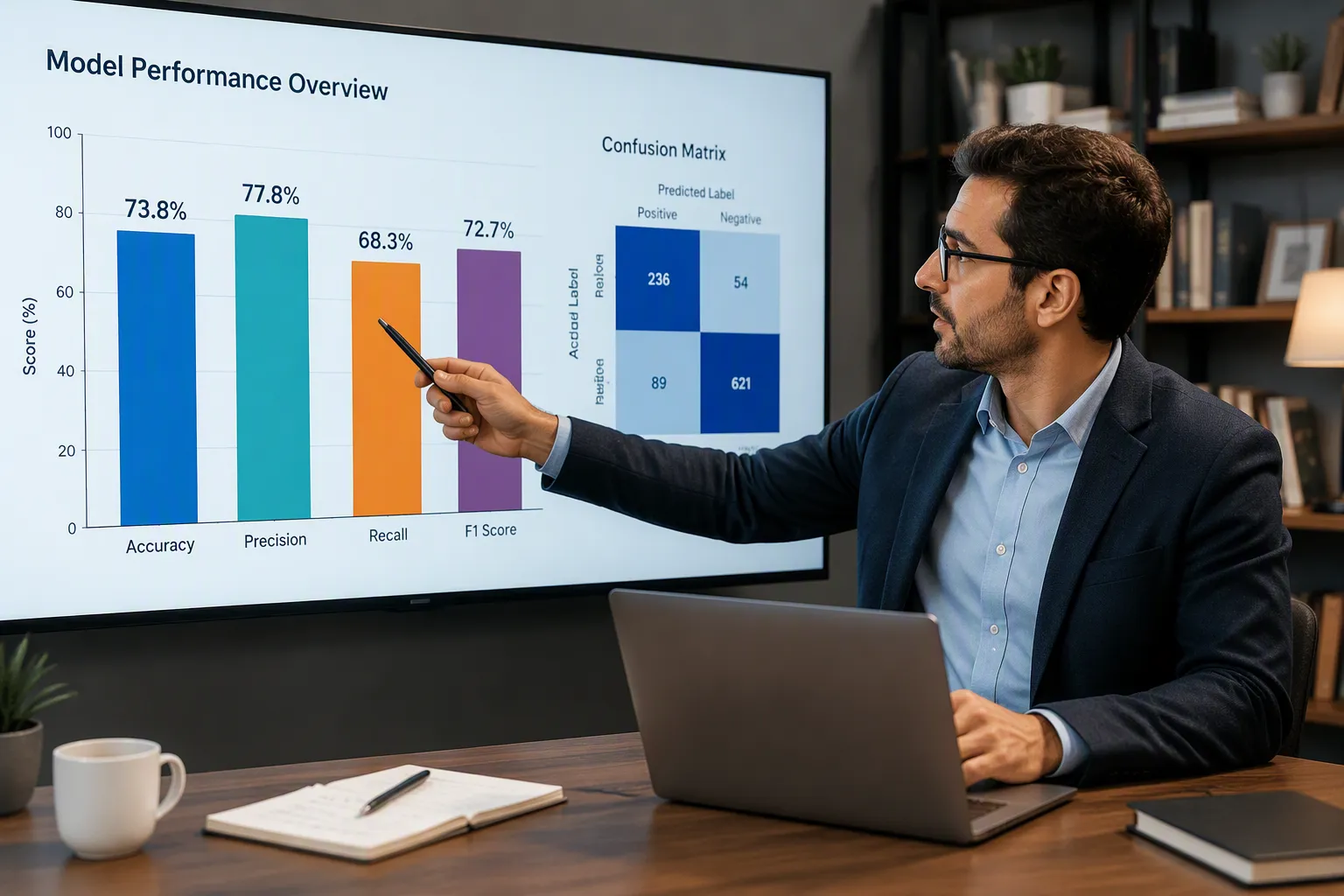
Independent tests show how ZeroGPT really works. The overall accuracy numbers tell the story.
| Metric | Value |
|---|---|
| Accuracy | 73.8% |
| Precision | 77.8% |
| Recall | 68.3% |
| F1 Score | 72.7% |
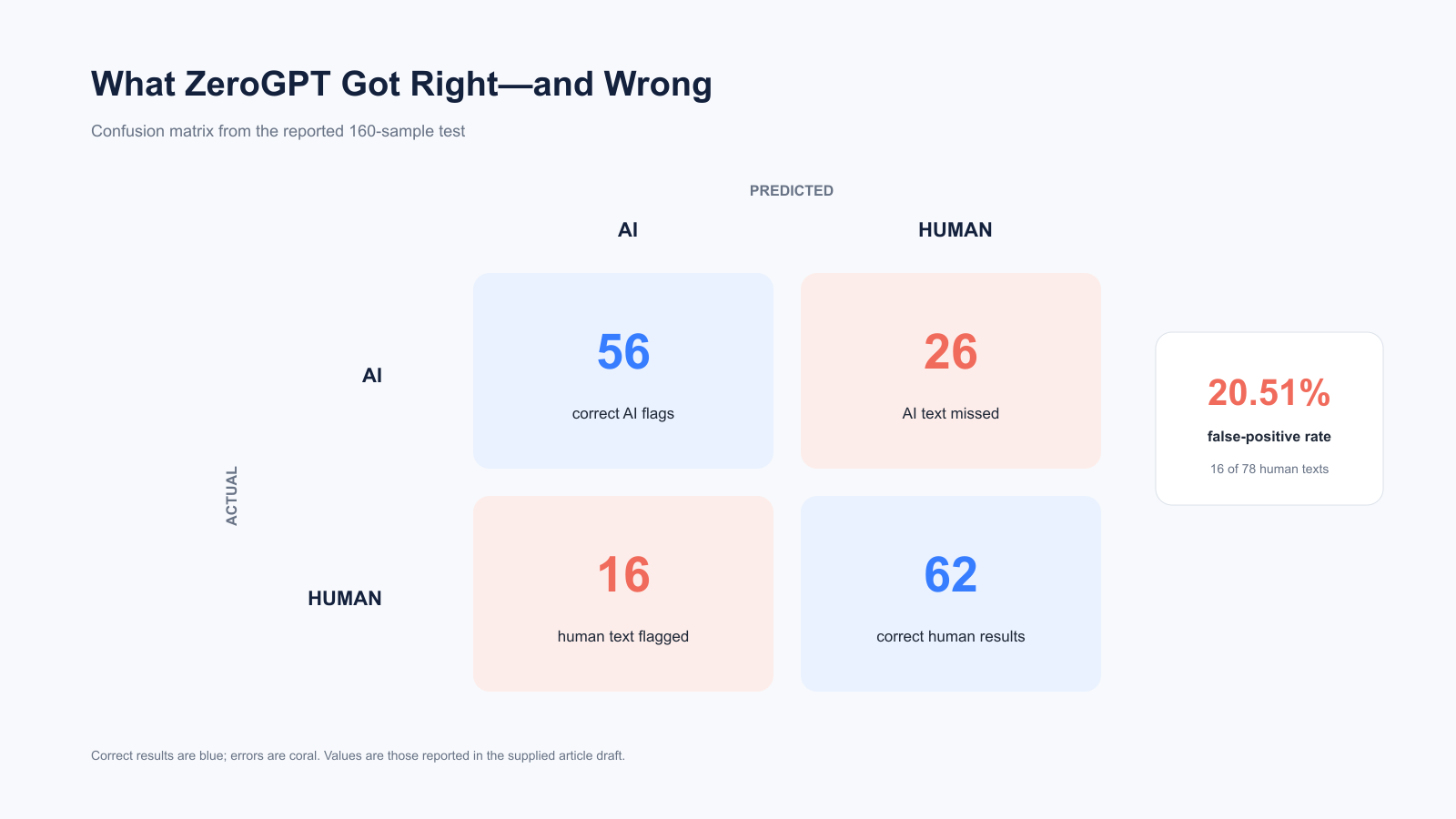
The 73.8% accuracy is much lower than the 98% claim. The confusion matrix shows the details.
| Actual \ Predicted | AI | Human |
|---|---|---|
| AI | 56 | 26 |
| Human | 16 | 62 |
The detector found 56 AI texts out of 82. It missed 26 AI texts. It correctly picked 62 human texts out of 78. It wrongly flagged 16 human texts as AI. This gives a false positive rate of about 20.51%.
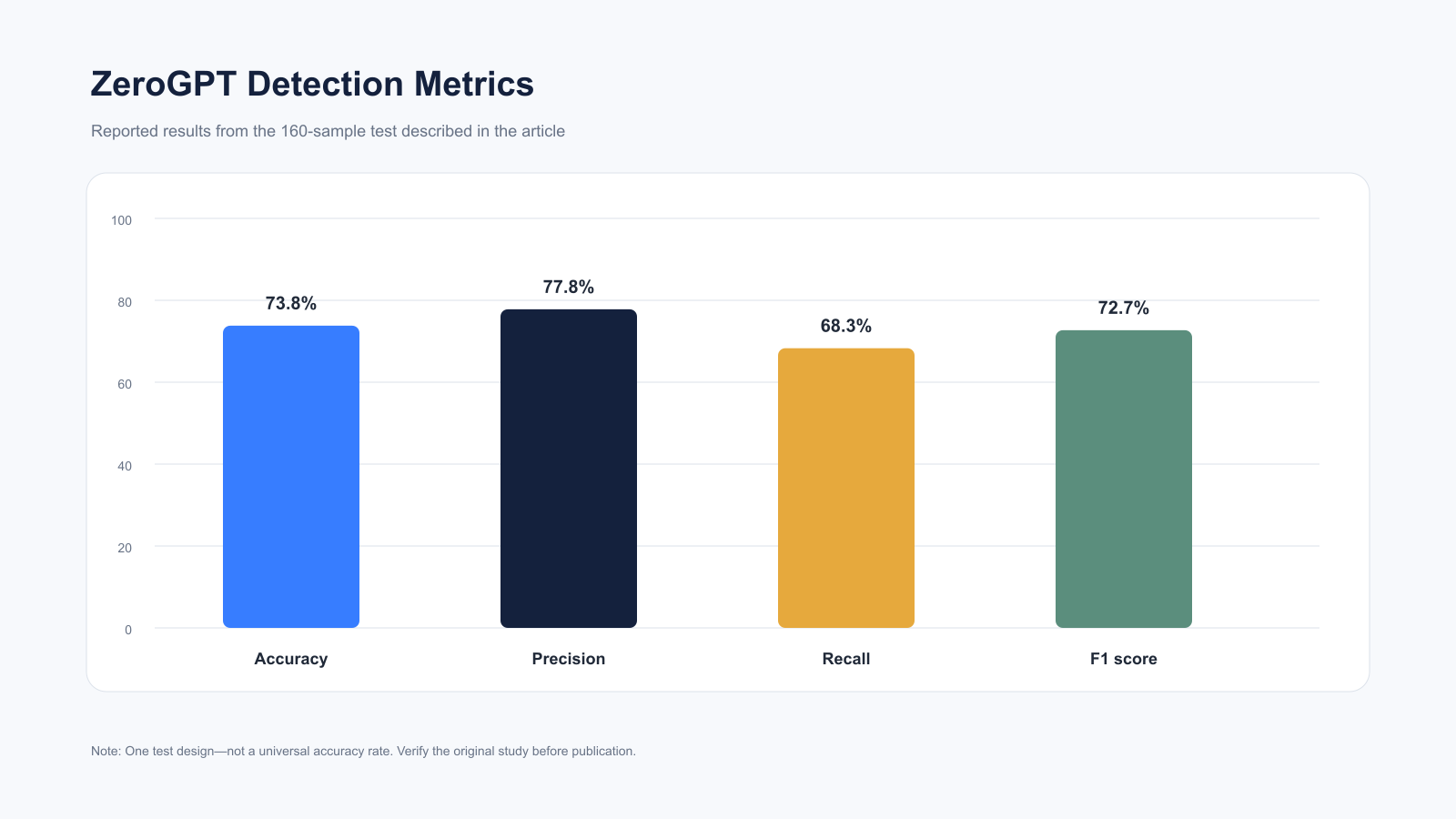
The chart shows the gap between the numbers. Accuracy, precision, recall, and F1 score are all below 80%.
AI Essay Detection Success
ZeroGPT does well on some types of AI content. One test used the Phrasly.AI method. It found ZeroGPT caught 3 out of 3 AI essays. The tool correctly marked poor AI text as 100% AI-generated. This shows the detector is good at finding obvious AI content.
The detection rate for AI text in the confusion matrix shows 56 correct finds out of 82 AI samples. That gives a recall of 68.3%. The tool catches most AI content but still misses some.
Human Text False Flagging
The false positive problem is ZeroGPT’s biggest weakness. One test showed that poor human text was flagged as about 75% AI-generated. This is a false positive. Good human text was flagged as 16% AI-generated. That is also a false positive, and highly structured writing can trigger more false positives, so in some scenarios ZeroGPT shows more false positives than competing tools. The overall accuracy on this test was only 25% (1 out of 4 tests passed).
The Turnitin comparison study confirms this issue. ZeroGPT had a false positive rate of 20.51%. That means roughly 1 in 5 human-written samples were wrongly flagged as AI. Turnitin had a false positive rate of only 1.28%, which matters when evaluating human-authored work because users need fewer false positives and fewer false alarms. The difference is huge.
What ZeroGPT does well
- Low-friction access: ZeroGPT is a convenient free AI detector for quick checks, and the current plan publishes a 15,000-character per-scan allowance.
- Fast screening: It returns an overall classification and highlights passages for review.
- Generous input size: The free limit is enough for many essays and blog posts without splitting them into tiny samples.
- Useful first-pass signal: It can identify obvious, unedited AI-generated writing in favorable conditions.
- Paid workflow features: Higher tiers add larger scans, batch file checks, detection history, batch uploads, and PDF reports.
Where ZeroGPT is weak
- No universal independent accuracy rate: Published performance ranges widely across datasets, with uneven detection accuracy from one benchmark to another.
- False-positive risk: Formal, predictable, or non-native English can be incorrectly flagged, so the detector can label both AI written content and human text inconsistently when prose is formal, edited, or mixed.
- False-negative risk: Edited, paraphrased, mixed, or newer-model text can evade detection.
- Opaque score interpretation: Users are shown a precise percentage without the complete calibration evidence needed to treat it as authorship probability.
- Poor fit for high-stakes proof: A detector result cannot reconstruct the writing process.
My verdict
ZeroGPT can still be useful as a first-pass among ai detection tools when the question is, “Which passages should I look at more closely?” It is not reliable enough when the question is, “Can I prove this person used AI?” I would keep it only as a free reliable tool for low-stakes screening, not for proof, then move to evidence the writer can actually explain: drafts, notes, sources, document history, and subject knowledge.
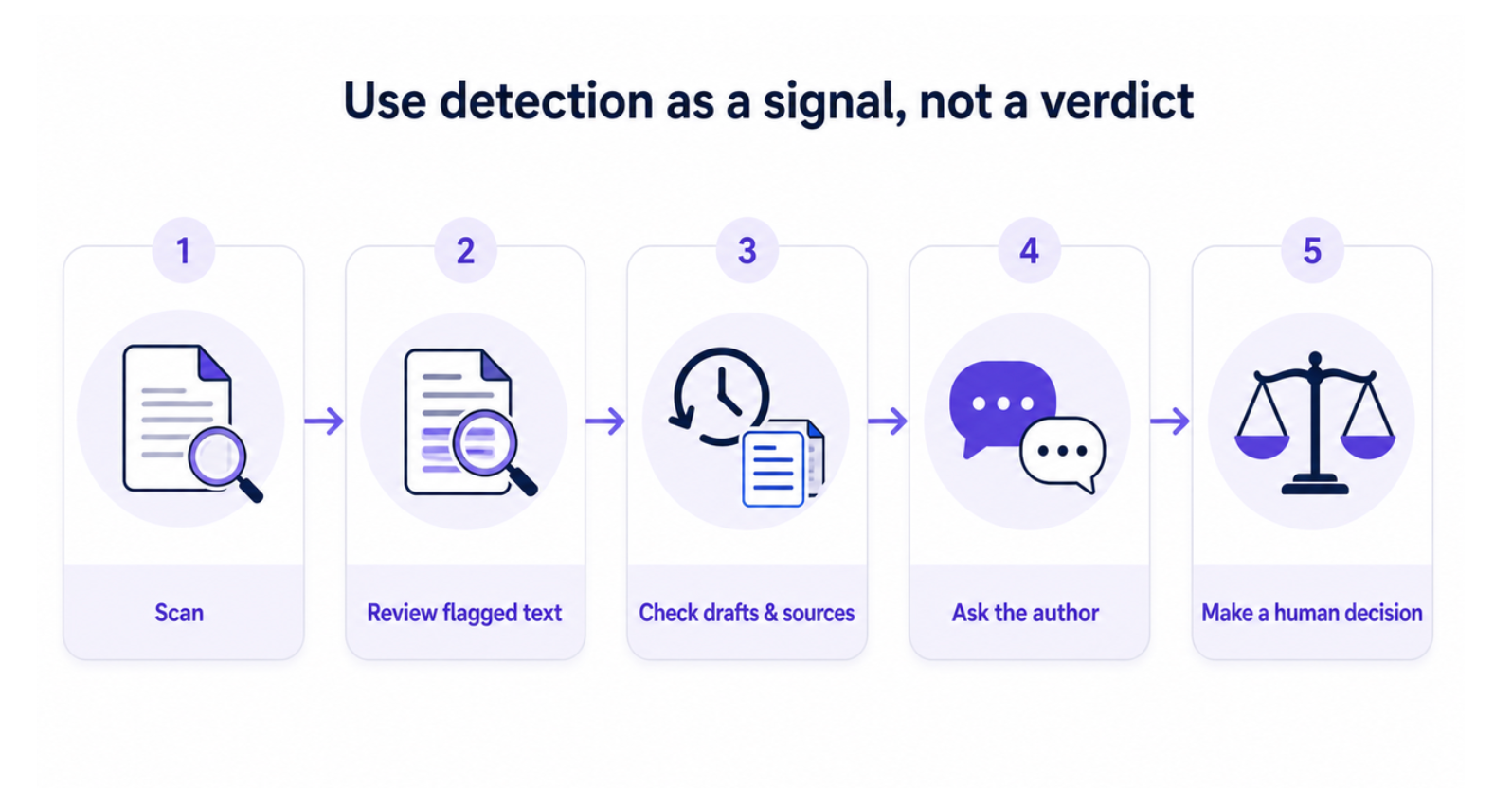
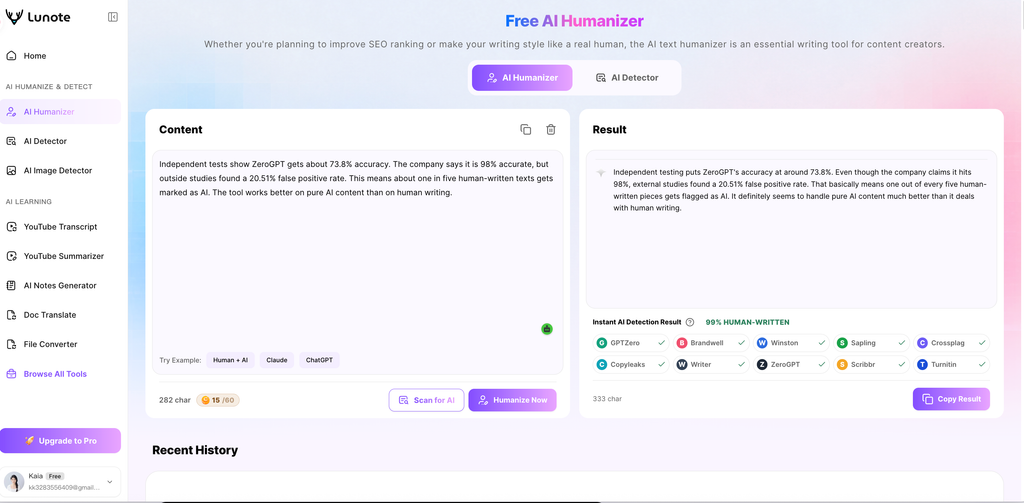
Writers who want another readable first-pass result can compare it with Lunote’s AI Detector. Detector disagreement should not be solved by averaging percentages. It should trigger closer review of the text and the writing process.
So, Is ZeroGPT Reliable for Students and Teachers?
For students
Use ZeroGPT, if at all, as a private warning that a passage may sound formulaic, since it only evaluates the final text and does not prove ai involvement in your process. Do not destroy a genuine draft because one detector objects to it. Keep your outline, notes, research history, citations, local files, and cloud revision history to help defend your own writing if the tool flags it incorrectly. If you used AI within the course policy, document what it did and what you changed.
If a human-written essay is flagged:
- Save the detector result and the exact version of the submitted text.
- Preserve drafts and document history; do not overwrite them while panicking.
- Review citations and be prepared to explain the argument in your own words.
- Ask which institutional policy and evidence standard will be applied.
- Request human review rather than trying to “beat” the detector.
For teachers
Use a flag to decide what to review, not whom to punish. Compare the passage with prior work, assignment-specific knowledge, sources, and revision history. Ask neutral questions about how the argument developed. Give students a documented opportunity to explain their process.
A responsible policy should define:
- what kinds of AI assistance are permitted;
- what disclosure is required;
- what minimum text length is meaningful;
- whether a second detector or reviewer is required;
- how non-native English and accessibility tools are handled;
- which evidence can support an adverse decision;
- how students can appeal.
For writers, editors, and clients
Do not make payment contingent on one detector score. A writer can be falsely flagged, and an AI-generated draft can pass. Contract for the outcomes you actually need: original reporting, accurate facts, cited sources, documented interviews, brand voice, and disclosure of prohibited assistance.
The broader Lunote workspace is designed for reviewing, translating, transcribing, and improving content, but no tool in the workflow replaces editorial accountability. Check Lunote pricing if you need detection alongside other document tools rather than a detector-only subscription.
How ZeroGPT Differs from Other AI Detectors? Comparison With My Real Test
ZeroGPT uses Natural Language Processing (NLP) to study text structure, sentence patterns, and word choice. It uses machine learning models and deep neural networks. These are trained on big sets of AI and human writing. This training helps the detector spot repeated sentence structures, strange flow, and common AI writing traits.
The system keeps improving its model with more training. This helps ZeroGPT get better at detecting AI from tools like ChatGPT, Gemini, and Claude. Unlike simple detectors that use just one measure, ZeroGPT uses many layers of analysis. This method tries to catch small AI patterns that other tools miss.
But this sensitivity causes the false positive problem we talked about. The same pattern detection that finds AI text also flags human writing that looks similar. People who do not speak English as a first language and writers of standard content are at highest risk. Knowing how ZeroGPT works shows why it acts this way. The tool focuses more on catching AI text than on protecting human writers from being wrongly accused.
ZeroGPT vs. Lunote AI Detector
The question “Is ZeroGPT Accurate” becomes clearer when compared to Lunote. The expert review rates Lunote as a fast, readable detector with clear explanations and broad multi-model coverage. It recommends Lunote as the best starting point for most users. ZeroGPT is described as a quick, no-sign-up tool with a large free allowance. But it has less clear independent support for its accuracy claims.
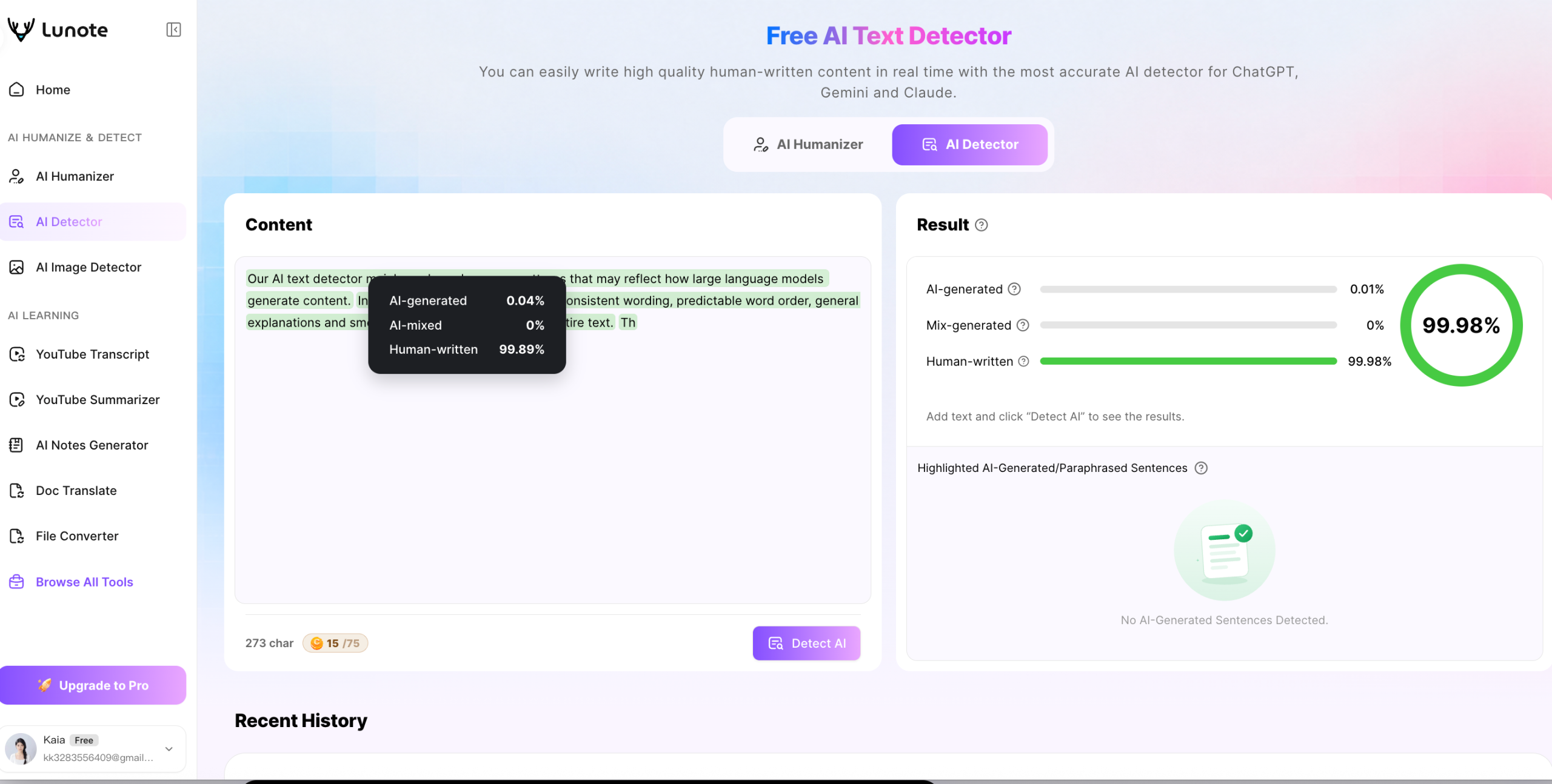
The following table compares the two tools.
| Feature | Lunote | ZeroGPT |
|---|---|---|
| Overall detector workflow | Best all-around | Basic scan |
| Best choice for most users | Yes | No |
| Clarity of result explanation | Very clear | Basic |
| Multi-model AI detection coverage | Broad | Good |
Lunote offers a 99% accuracy rate with a 4.9 average rating from thousands of users. ZeroGPT claims 98% accuracy but independent tests show 73.8%. The difference in reliability is clear. For important decisions, Lunote is the better choice.
Is ZeroGPT as Accurate as Turnitin?
ZeroGPT is not a preview of Turnitin. The two systems use different models, thresholds, product categories, datasets, and reporting rules. A ZeroGPT score of 20% does not imply Turnitin will report 20%, and a “human” ZeroGPT result does not guarantee that Turnitin will agree.
Turnitin is designed for institutional submission workflows and combines a plagiarism checker with a separate AI writing indicator. ZeroGPT is a public detector with a generous free interface and optional paid batch tools. The 2025 JALT study found Turnitin more accurate and consistent than ZeroGPT in its set of AI-generated and edited documents, but that result should not become a universal guarantee either.
Most importantly, Turnitin’s own guidance says its AI model may misidentify human-written, AI-generated, and AI-paraphrased text and should not be the sole basis for adverse action. If the institutional provider itself requires human judgment, a public ZeroGPT score certainly should not override it.
Students should follow the school’s disclosed AI policy rather than chase agreement between public detectors. Teachers should ask for drafts, citations, version history, or an oral explanation before reaching a misconduct conclusion, and in those institutional workflows Turnitin generally does a better job because staff review results with human judgment rather than treating them as standalone proof.
Is GPTZero or ZeroGPT More Accurate?
For the primary keyword cluster, this is the most important comparison. The names are easy to confuse, but GPTZero and ZeroGPT are separate products.
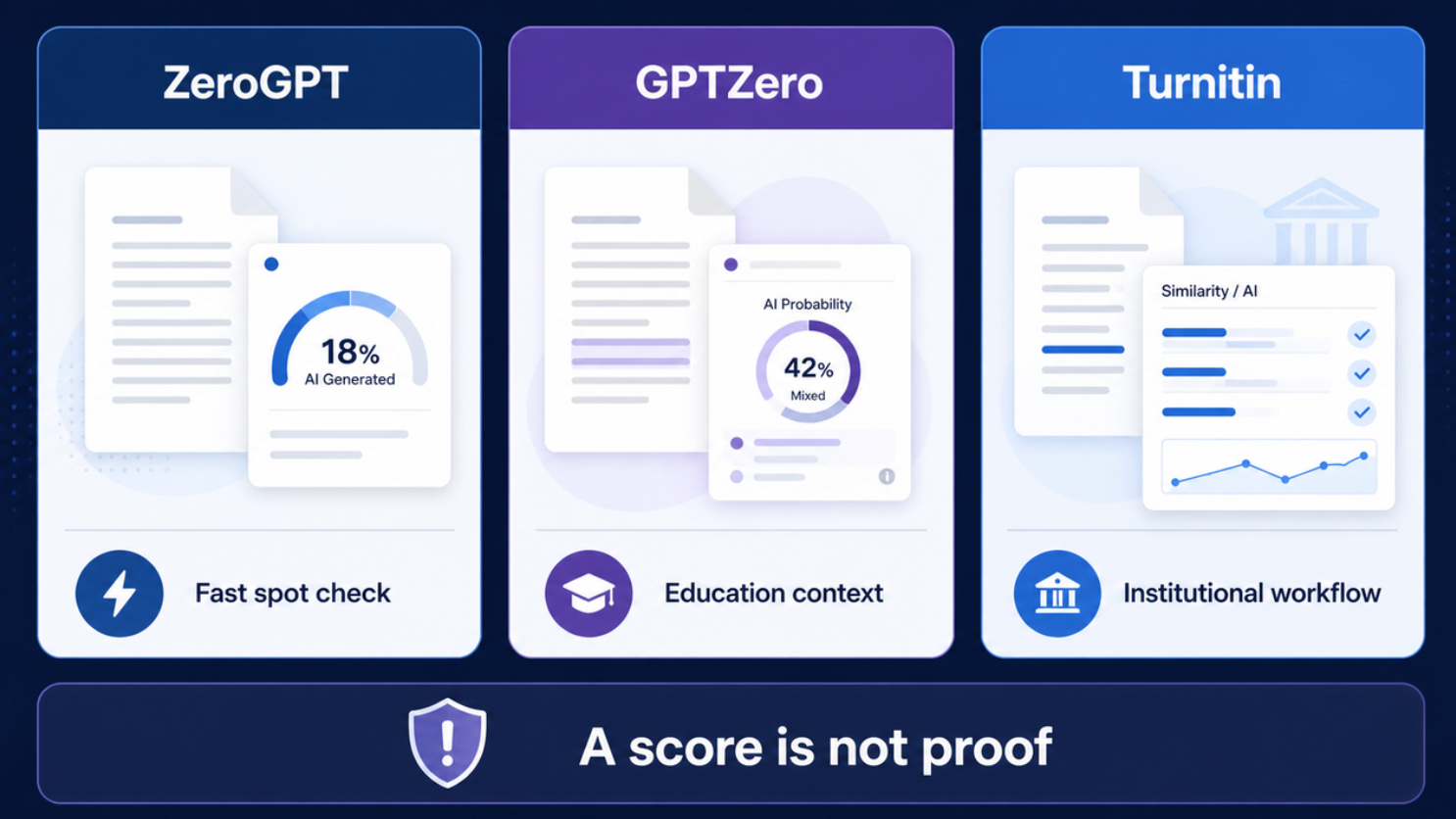
Alt: ZeroGPT vs GPTZero vs Turnitin comparison for fast spot checks, education context, and institutional AI detection workflows
| Factor | ZeroGPT | GPTZero |
| Best practical fit | Fast, generous, no-cost spot checks | Education-oriented investigation and writing-process context |
| Free access | 15,000 characters per detection listed | Free monthly allowance; current limit depends on plan |
| Recent scholarly abstract study | 64.35% accuracy in the original-vs-AI scenario | 97.22% accuracy in the same scenario |
| Reporting emphasis | Overall result and highlighted AI-like sentences | Document/sentence analysis plus education and authorship workflows |
| Main risk | False positives and substantial false negatives across unfamiliar samples | Still probabilistic; can also misclassify human or edited content |
| High-stakes use | Screening only | Better investigative context, but still not proof |
On the recent PeerJ dataset, GPTZero was more accurate. On another dataset or future tool version, the gap could change. If I were selecting a system for an education team, I would prefer the product that supports process evidence, repeatable reports, appeals, and policy—not simply the detector that gives the lower score on one student essay.
For a wider comparison, see our evidence-led guide to the best AI text detectors in 2026. It explains why false-positive cost, reporting clarity, text length, and governance matter as much as headline accuracy.
Is QuillBot or ZeroGPT More Accurate?
QuillBot’s AI detector and ZeroGPT both offer free checks, but a simple universal ranking is not supported by the available evidence. QuillBot is part of a broader editing suite; ZeroGPT offers a larger published per-detection character allowance and a more detector-centered paid workflow.
The decision should be practical:
- Use ZeroGPT when you need a quick scan of a longer passage without building an editing workflow around it.
- Use QuillBot when detection is one step inside grammar, paraphrasing, and revision tools you already use.
- Use neither score as proof of authorship.
- Do not run text through a paraphraser only to lower a detector result. The JALT study found paraphrasing materially reduced detector performance, which makes the score less informative—not the authorship more legitimate.
If stiff or generic language is the actual problem, revise for the reader. Lunote’s AI Humanizer can help reshape awkward AI-assisted prose, but facts, citations, voice, and disclosure still require human review.
User Feedback and Reviews on ZeroGPT Accuracy
User reviews show a mixed view of ZeroGPT. Some people like how fast and simple it is. Others report big problems with false positives. This pattern shows up again and again on Reddit threads and Trustpilot reviews.
Is ZeroGPT accurate? Reddit users focus on false accusations
In the Reddit thread “ZeroGPT is NOT RELIABLE AT ALL”, users describe human-written material and older texts receiving AI flags. Other discussions report old school essays, scholarship applications, religious text, and independently written assignments receiving unexpectedly high scores. These are anecdotes rather than controlled accuracy studies, but they reveal the user pain clearly: people are less worried about a detector missing bland AI copy than about being unable to prove they wrote genuine work, and many users are especially frustrated by false accusations on authentic writing.
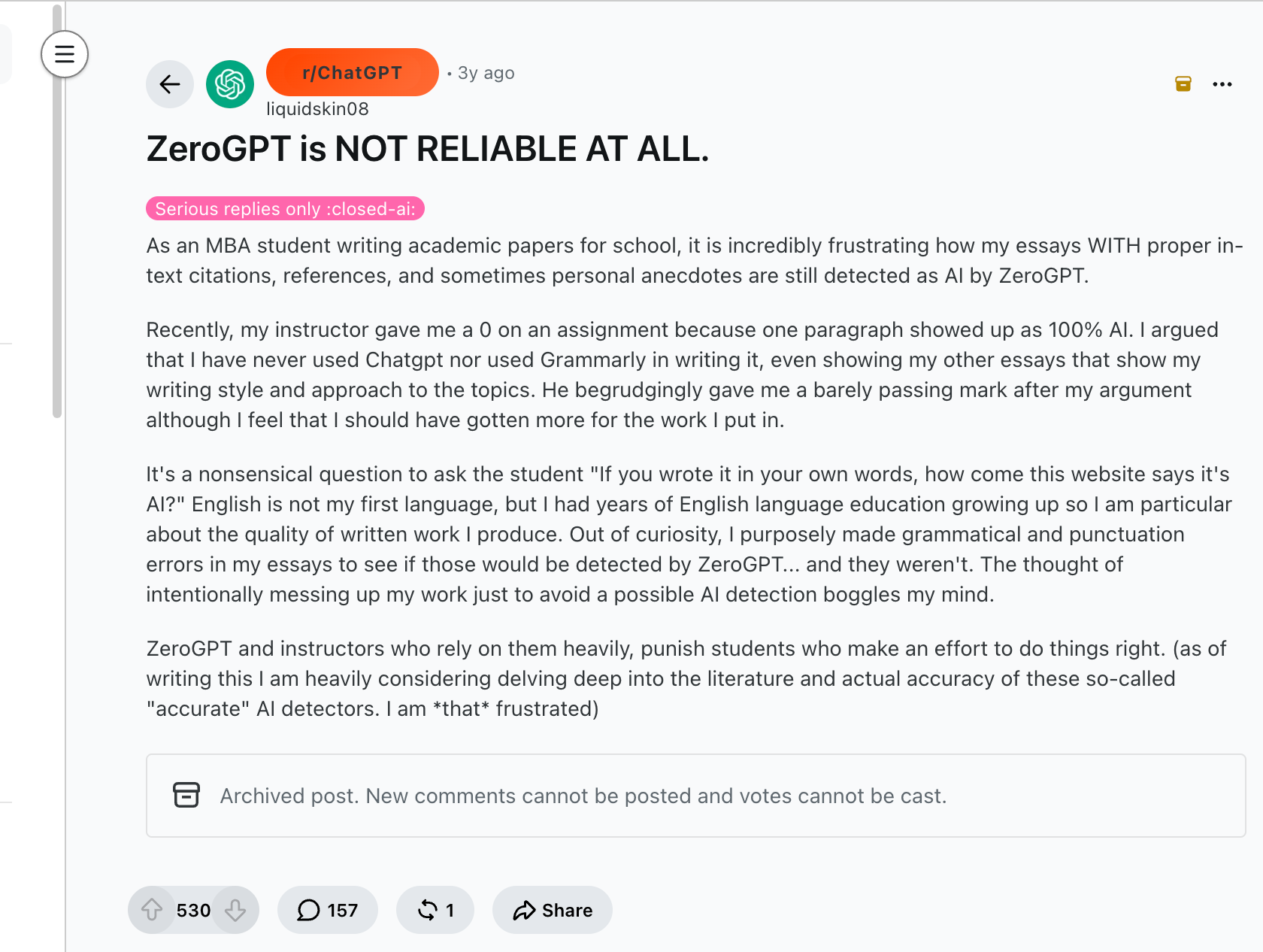
Human writing may look “AI-like” when it contains:
- formal academic language and repeated disciplinary phrases;
- short sentences with predictable syntax;
- carefully proofread grammar and consistent transitions;
- definitions, introductions, templates, or standardized business copy;
- English written by a non-native speaker;
- translated or accessibility-assisted language;
- a short sample without enough stylistic variation.
The correct response is not to insert random mistakes. A false-positive risk does not make inaccurate grammar, artificial sentence variation, or needless slang more human. It makes process evidence more important.
Common Complaints About False Positives
The most common complaint is false positives on human-written text. Users say ZeroGPT flags academic papers as AI-generated even when the author wrote every word. One review showed a fully human-written academic text that got a 100% AI probability score. The reviewer called this a severe false positive.
The table below shows specific examples from user testing.
| Content Type | ZeroGPT Score | Implication |
|---|---|---|
| Fully human-written academic text | 100% AI | Severe false positive; triggers integrity risks |
| Fully AI-generated content | 100% AI | Correct detection but no differentiation |
| Lightly edited AI content | 100% AI | Over-detection; fails to distinguish human edits |
The tool shows no difference between pure AI text and lightly edited AI text. Both get the same 100% score. This lack of precision frustrates writers who revise AI drafts with their own words. The review noted that ZeroGPT is overly sensitive to academic structure and lacks precision. False positives remain a risk, especially for academic or research-style writing.
Students often say ZeroGPT is highly sensitive and inconsistent. A 2024 study tested four detection tools on ChatGPT-4 and human text. ZeroGPT gave inconsistent results and showed significant variability in accuracy. The study confirmed a clear risk of false accusations against human-written content.
Positive Experiences with ZeroGPT
Despite the false positive problems, some users report good experiences. The tool works well on raw, unedited AI text. Users on Reddit praise its performance when checking content that clearly comes from ChatGPT or similar tools. The interface requires minimal steps and delivers results quickly.
ZeroGPT is fast, accessible, and extremely confident at detecting AI-generated text. It offers one of the most generous free access models in its free version (15,000-character scan limit with no account required), making it feel almost completely free for casual users. Its pricing is more affordable than major competitors like GPTZero, Winston AI, and Originality AI.
Paid plans also promote an ad free experience and extra tools beyond basic detection.
The table below summarizes positive feedback from users.
| Positive Aspect | Specific Feedback from Users |
|---|---|
| Ease of Use | Interface is extremely simple and intuitive; operation requires minimal steps, ideal for quick checks. |
| Speed | Processing time is fast, delivering results quickly. |
| Affordability | Subscription plans are lower-cost than competitors; offers good value for basic to moderate use. |
| Free Tier | More generous free tier with higher word count limits, making it accessible for casual users. |
Trustpilot users also praise the sentence-level highlighting feature. This tool shows which specific sentences appear artificial. Writers can see exactly where the detector finds problems. This insight helps with revisions, even when the overall score seems wrong.
Analyzing Online Ratings and Testimonials
ZeroGPT does not provide any third-party average ratings or named customer testimonials on online review sites. The only claims come from vendor statements about millions of users trusting the detector. No independent review scores are available for verification.
The table below compares feedback across platforms.
| Source | Positive Feedback | Negative Feedback |
|---|---|---|
| Reddit threads | Praises performance on raw, unedited AI text | Criticizes high false positives and inconsistency with edited/human-written content |
| Trustpilot users | Praises sentence-level highlighting for insights | Calls it unreliable for high-stakes use like grading or publishing |
The absence of verified ratings makes it hard to judge overall satisfaction. Users must rely on anecdotal reports from forums and review sites. The pattern shows a clear divide. Casual users appreciate the free access and speed. Professional users worry about the consequences of false accusations. This split explains why the question of ZeroGPT accuracy remains unresolved.
Limitations of ZeroGPT
Dependence on Text Length and Language
ZeroGPT works unevenly based on text length and the writer’s language. Short passages cause real issues for the detector. Texts under 500 words show false positive rates above 30%. A student posting a short discussion or email faces a high risk of being wrongly flagged. The tool needs enough words to find patterns. With fewer words, the analysis becomes less reliable, and when researchers tested ZeroGPT, results varied even more with brief or formulaic samples.
Language background also changes results in worrying ways. A 2024 study from MDPI found that non-native English speakers had false positive rates three times higher than native speakers. The tool sees simple words and regular sentence patterns. These features look like AI writing. A writer from another country who follows grammar rules closely becomes an easy target. The detector cannot tell the difference between careful second-language writing and machine output, and weak multilingual support or uneven cross-language performance likely adds to these errors.
The table below shows key limits from testing.
| Limitation | Key Evidence |
|---|---|
| High False Positives | False positive rates ranged from 5% to 30%; a Brandeis University study flagged 22% of human-written essays; rates exceed 30% on texts under 500 words |
| Bias Against Non-Native Speakers | Non-native English speakers had 3× higher false positive rates than native speakers |
| Inconsistent Results | The same 1,000-word essays submitted five times gave scores from 45% to 91% AI, with a standard deviation of 16.7% |
Struggles with Polished AI Content
ZeroGPT loses accuracy when AI text has been edited or refined. Simple paraphrasing tools cut detection sharply. One benchmark test showed that paraphrasing dropped detection from 94% to 10%. Human editing let 82% of modified texts escape detection entirely. Hybrid methods, where a person rewrites parts of AI output, had detection rates below 5%.
This weakness matters because most real-world AI use involves some editing. A student might create a draft with ChatGPT, then rewrite sentences in their own voice. A professional might use AI for research and then polish the final copy. ZeroGPT fails to catch these cases. The tool only works well on raw, unedited AI text. Once a human touches the content, the patterns change enough to fool the detector.
The inconsistency problem makes things worse. Controlled testing showed that the same 1,000-word essays submitted five times produced scores from 45% to 91% AI. The standard deviation reached 16.7%. Users cannot trust a single score. The same text might pass one day and fail the next. This unpredictability makes ZeroGPT unreliable for any serious evaluation.
Ethical Concerns and Potential Misuse
The high false positive rate creates serious ethical problems. Companies that sell AI detectors face a big business risk. Generative AI makes old plagiarism detection outdated. This situation creates huge market demand from educators. The promise of a multi-billion dollar industry tempts vendors to sell unreliable tools. ai detectors legal to use is not the same as ethical or reliable enough for punishment.
The basic engineering challenge of detecting AI writing remains unsolved. Yet companies keep selling these products. Accuracy claims get exaggerated to keep revenue flowing. Students face accusations based on flawed technology. A false accusation can damage a student’s academic record and reputation. The tool that should protect academic integrity instead hurts it.
The table below shows false positive rates from different studies.
| Study | Sample Size | False Positive Rate |
|---|---|---|
| Gao et al. | 50 original abstracts | 2% (1 out of 50 scored above 50%) |
| Rashidi et al. | 14,400 abstracts (1980–2023) | Up to 8% incorrectly identified as AI-generated |
| Current study (PMC12331776) | 250 pre-ChatGPT articles | ZeroGPT: 16% scored above 50% |
ZeroGPT also lacks independent checks. The tool has not been tested in the RAID benchmark. It did not join the GenAI Content Detection Shared Task. A Google Scholar search returns zero peer-reviewed papers on the tool. Users must rely on vendor claims about AI involvement detection without enough outside proof. This lack of scrutiny raises questions about the 98% accuracy figure.
Recommendations and Alternatives of Zerogpt
When to Use ZeroGPT
ZeroGPT has a specific job. It works best as a quick check, not as the final word. The tool does well on raw, unedited AI content. It has trouble with polished human writing and edited AI text. Users should know these limits before trusting the results.
The table below shows which user groups benefit most from ZeroGPT’s quick-check function.
| User Group | Appropriate Situation for Using ZeroGPT |
|---|---|
| Students | Quickly checking if an essay might trigger AI detection before submission |
| Educators | Running a preliminary scan to decide if deeper investigation is needed |
| Freelance writers | Reviewing drafts to see if structured sections resemble AI-generated language |
| Content teams | Performing quick checks on blog posts, articles, or marketing copy before publication |
| Editors | Evaluating submissions and wanting a fast signal about potentially AI-written passages |
| General users | Comparing different AI detectors to understand how tools interpret AI-like writing patterns |
ZeroGPT works well in three specific cases. First, it helps with quick spot-checks of obvious AI content. A teacher scanning thirty submissions can flag clearly machine-written work. Second, it gives a second opinion when users run the same text through multiple tools. Third, it offers initial awareness for people who have never thought about how their writing scores on AI detectors.
ZeroGPT is worth using when the goal is quick insight rather than strict enforcement. It works best as an early signal in a writing workflow — a fast screening layer, not the only authority in the process.
Academic settings need extra care. Structured, formal, and evidence-based writing often looks like AI text. ZeroGPT may falsely flag essays, lab reports, or discussion posts even when human-authored. Experts suggest treating ZeroGPT as a screening tool, not a verdict. Users should test larger samples, review the whole document, and cross-check with other detectors. Combining detector output with draft history and direct communication with the writer prevents unfair accusations.
Better Alternatives for Critical Decisions
High-stakes decisions need tools with proven reliability. ZeroGPT’s false positive rate of 20% or higher makes it risky for academic misconduct cases or professional publishing. More accurate detectors exist for these situations.
Why Lunote AI Detector Excels
Lunote AI Detector stands out as the best starting point for most users. It offers 99% accuracy with a 4.9 average rating from thousands of users. The tool supports over 350,000 scans monthly across more than 50 languages. Its multi-layered analysis examines language model characteristics, sentence structure, word choice, and writing style. This approach cuts false positives significantly.
The detector provides sentence-level highlights. Users see exactly which passages appear artificial and why. A detailed breakdown shows AI, mixed, and human-written percentages. This clarity helps writers revise targeted sections instead of rewriting entire documents. The free AI humanizer also helps refine flagged content while keeping the writer’s natural voice. For students, educators, and professionals, Lunote delivers actionable insights that ZeroGPT cannot match.
Other Reliable Detectors to Consider
Several other tools beat ZeroGPT in accuracy benchmarks. Pangram Labs delivers the cleanest split between human and AI text. Copyleaks offers strong performance plus plagiarism checking for broader integrity workflows. Winston AI balances performance and usability with detailed, inspectable output. GPTZero takes a more cautious approach, avoiding the bad false positives that plague ZeroGPT.
The table below compares false positive rates across detector categories.
| Tool | False Positive Rate | Notes |
|---|---|---|
| Turnitin | 1–2% | Gold standard for academic institutions |
| Pangram Labs | 1/10,000 (0.01%) | Extremely low false positive rate |
| Top paid tools (e.g., Originality.AI) | <2% | Aim for under 2% |
| Free tools (including ZeroGPT) | 20% or higher | High false positive rates make them unreliable for critical decisions |
Turnitin and Pangram Labs show false positive rates far below ZeroGPT’s typical 20%+. These tools provide the accuracy needed for academic integrity investigations and professional content verification. Users facing serious consequences should choose these alternatives over ZeroGPT.
ZeroGPT delivers moderate accuracy but carries a high false positive rate. This makes the tool risky for academic or professional settings. The answer to “Is ZeroGPT Accurate” depends on the use case. For quick checks, the tool works fine. For critical decisions, more reliable options exist.
Lunote AI Detector offers 99% accuracy with sentence-level highlights. It provides a detailed breakdown of AI, mixed, and human-written percentages. Users see exactly which passages appear artificial. The explanations help writers revise targeted sections.
Choose a detector based on your specific needs. Always verify results manually. No tool replaces human judgment. The best approach combines multiple checks and careful review.
Conclusion: Can You Trust ZeroGPT?
You can trust ZeroGPT to provide a quick model-based opinion. You cannot trust it to establish authorship by itself.
The strongest evidence is mixed. ZeroGPT reached 98% accuracy in one controlled short-physics-essay study, yet only 64.35% in a newer cross-disciplinary scholarly-abstract study. Community reports repeatedly describe false positives, while research on edited text shows why false negatives also matter. The product’s free 15,000-character scan and simple interface make it useful for low-stakes screening, but a precise score should not be confused with proof.
My recommendation is straightforward:
- Use ZeroGPT for fast, free first-pass screening of substantial text.
- Compare tools cautiously when the result matters, without averaging incompatible percentages.
- Prefer process evidence for academic, hiring, publishing, or payment decisions.
- Never punish or certify authorship from one score.
AI detection is most responsible when it starts a review, not when it ends one.
What to Do When ZeroGPT Says Your Human Writing Is AI
First, do not rewrite randomly. A detector can reward choppy sentences or unusual vocabulary even when those changes make the content worse.
Instead:
- Confirm the sample. Make sure the pasted text is complete and has not lost headings, quotations, or formatting that affect interpretation.
- Check length. A short paragraph is less informative than a substantial section.
- Read the flagged passages. Look for generic claims, repeated sentence patterns, missing examples, or unsupported transitions—not because those prove AI use, but because they may need editorial work.
- Protect meaning. Do not change names, numbers, quotations, citations, or technical terms to satisfy a score.
- Preserve provenance. Keep drafts, notes, tracked changes, and source history.
- Use another detector only as context. Disagreement is expected; it does not establish innocence or guilt.
- Request human review. For academic or professional consequences, the decision-maker should evaluate process evidence.
The goal is clear, defensible writing. It is not a “0% AI” badge. If you want to compare how another interface explains linguistic signals, try the Lunote AI Detector, then return to the text itself rather than chasing scores.
FAQ
How accurate is ZeroGPT really?
Independent tests show ZeroGPT gets about 73.8% accuracy. The company says it is 98% accurate, but outside studies found a 20.51% false positive rate. This means about one in five human-written texts gets marked as AI. The tool works better on pure AI content than on human writing.
Why does ZeroGPT flag my human-written essay as AI?
ZeroGPT looks for predictable patterns, regular sentence structures, and steady rhythm. Many human writers naturally use these features. Academic writing, technical documents, and non-native English text often match AI patterns. The detector cannot tell careful human writing from machine output in these cases.
Can ZeroGPT detect edited AI content?
ZeroGPT has trouble with edited AI text. One benchmark test showed paraphrasing dropped detection from 94% to 10%. Human editing let 82% of modified texts escape detection. The tool only works reliably on raw, unedited AI output. Once a person revises the text, detection becomes unreliable.
Is ZeroGPT safe to use for academic integrity checks?
ZeroGPT carries significant risk for academic settings. The 20.51% false positive rate means students face wrongful accusations. Non-native English speakers face even higher risks, with false positive rates reaching 62.5%. Turnitin offers a much lower false positive rate of 1.28%. Schools should choose more reliable tools.
What is the best alternative to ZeroGPT?
Lunote AI Detector offers 99% accuracy with a 4.9 average rating, and some alternatives also bundle extras in paid plans such as an AI paraphraser, grammar checker, AI summarizer, or even an AI chatbot. It provides sentence-level highlights and detailed breakdowns of AI, mixed, and human-written percentages. The tool supports over 50 languages and performs 350,000 scans monthly. For critical decisions, Lunote delivers far more reliable results than ZeroGPT.
How can I reduce false positives when using ZeroGPT?
Submit longer texts over 500 words. Review the full document rather than single paragraphs. Cross-check results with another detector like GPTZero or Turnitin. Keep draft history and notes to prove authorship. Never rely on a single ZeroGPT score for important decisions.
Does ZeroGPT work equally well for all languages?
ZeroGPT performs unevenly across languages. The tool shows higher false positive rates for non-native English writing. Simplified vocabulary and regular sentence patterns trigger false flags. Users writing in a second language face three times higher false positive rates than native speakers. The detector lacks reliable multilingual accuracy.
How often does ZeroGPT give inconsistent results?
ZeroGPT shows notable inconsistency. Controlled testing submitted the same 1,000-word essays five times. Scores ranged from 45% to 91% AI, with a standard deviation of 16.7%. The same text can pass one day and fail the next. Users cannot trust a single score from this tool.


[…] of AI much like traditional plagiarism when it misrepresents authorship. Lunote’s article on evaluating ZeroGPT accuracy reaches the same broader lesson from a different angle: detector performance changes across […]